Indigenous peoples’ situation in Russia criticised by UN Forum
At the 25th session of the UN Forum on Indigenous Peoples, a report titled “The Crime of Being Indigenous” was presented, which analyses the pressure and repression being carried out by Russian authorities against indigenous leaders. The document was compiled by the international Indigenous Peoples’ Solidarity and Development Fund “Batani” in collaboration with Olga Podopleva, a lawyer for the International Committee of Indigenous Peoples of Russia.
The Crime of Being Indigenous
The report examines the situation of indigenous peoples’ representatives and human rights defenders who, because of their work, have become the subject of investigations by various authorities. It focuses in particular on small indigenous communities, whose ability to defend themselves is limited. Under these conditions, even the slightest pressure on an activist can lead to serious consequences for the community, which may lose its representative or simply become marginalised, the document notes.
The source material used includes public sources, court rulings, materials from human rights organisations, and the media. Some information was obtained through direct contacts. However, the authors of the report feel it necessary to emphasise that a complete picture of the repressions cannot be obtained, as there are no official statistics, censorship is in place, and people fear for their safety. The report covers the period from 2019 to the present: while initially only a few activists were labeled as foreign agents, the situation changed drastically starting in 2022. Repression became systematic and is carried out in nearly all areas in which activists are active. While penalties were initially administrative, criminal cases are now being initiated, using terms such as “war censorship”.
Starting in 2025, entire communities have been criminalised, with anti-extremism and anti-terrorism legislation being used to target the activities of independent indigenous activists, which are linked to “separatist” and “terrorist” structures. A key factor in this has been the fact that in June 2024, a fictitious organisation—the “Anti-Russian Separatist Movement”—was added to the list of extremist organisations, purportedly comprising dozens of indigenous peoples’ organisations. In December 2025, searches were conducted at the homes of 17 indigenous activists, two of whom, Daria Yegereva and Natalia Leonhardt, were taken into custody. They are accused of participating in the activities of a terrorist organisation and face up to 20 years in prison. The report concluded that defenders of indigenous peoples’ rights in the Russian Federation operate outside the legal framework, and many activists have been forced to leave the country or cease public activities, resulting in entire peoples being unrepresented or simply silenced both domestically and internationally.
UN Forum for Indigenous Peoples
One of the main topics of the Indigenous Peoples’ Forum was the health of indigenous peoples. Pavel Suljandziga, president of the “Batani” Indigenous Peoples’ Fund, delivered a sharp and emotional presentation, speaking of a deep crisis affecting entire communities and of mental health. In his view, entire generations are living under the burden of injustice and inequality. However, the situation is currently deteriorating even further. “For speaking out about the colonisation of Russia’s indigenous peoples, I am facing a criminal investigation. In Russia today, people are being imprisoned for standing up for justice.”
He also noted that there are no actual statistics on the situation of Russia’s indigenous peoples, even though the authorities themselves assess the situation as favorable. Suljandziga shared the results of independent studies and cited the example of one indigenous community in which all adult men have been convicted of a crime. Most of the convictions are for poaching, yet hunting is a traditional way of life for indigenous peoples. One-third of deaths are suicides, and the average age of those who die in accidents is 36. “You see, indigenous peoples had their lands and resources taken away, and then they are labeled criminals simply because they want to feed their families,” said Suljandziga.
He also cited an example from Chukotka, where tuberculosis is spreading in rural areas—home to indigenous peoples. According to Suljandziga, since the start of the Russia-Ukraine war, pressure on indigenous activists has increased, with raids taking place and criminal cases being initiated. “Criminal cases are being fabricated, fictitious organisations are being declared a threat, and they are being linked to indigenous peoples.” Suljandziga concluded his presentation with a call: “Freedom for Daria Egereva, Natalia Leonhardt, and other political prisoners!”
Valentina Sovkina’s speeches
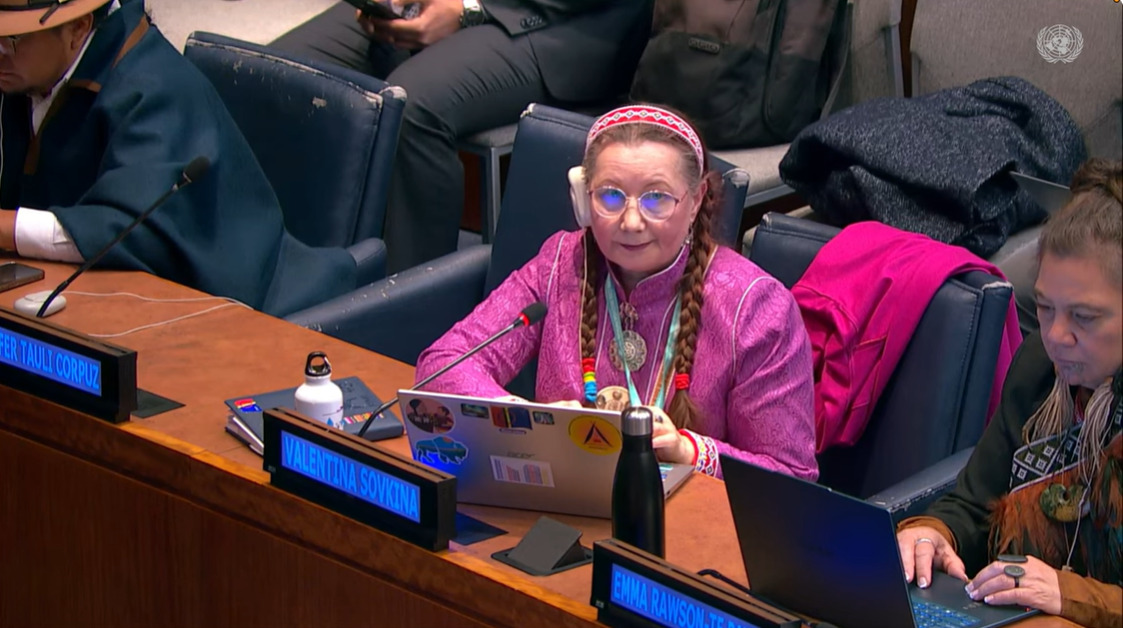
Valentina Sovkina, a representative of the Russian Saami, delivered two critical speeches. In December 2025, she was forced to leave the Russian Federation after her home was raided and the contents of her computer were confiscated. In the first presentation held in the climate section, she noted that the climate crisis is also exacerbating issues related to the rights of indigenous peoples and has already led to violations of those rights. For example, she pointed out that the climate crisis is increasing the pressure of large-scale industry on indigenous peoples’ territories and violating their rights, such as the right to self-determination.
In the Russian Federation, pressure on human rights defenders and indigenous leaders has increased significantly, particularly on those who participate in the work of international institutions. These facts are documented and are not isolated incidents, but rather a broader trend, Sovkina believes. In her view, the case of Darya Egereva is illustrative. It shows that indigenous peoples have no opportunity to defend their rights or participate in the work of international organisations. The development of indigenous peoples’ rights without rights, without agreements, and without justice—this is a continuation of colonial logic, Sovkina noted. She believes that the priority measures for defending the rights of indigenous peoples are the protection of indigenous leaders and ensuring their participation in international platforms.
In her second presentation, Sovkina noted that Russia’s indigenous peoples have historically lived in regions rich in various natural resources, such as gas, oil, and metals. These lands have become the focus of large-scale industry, which in turn leads to the displacement of indigenous peoples from their lands. Although the Constitution of the Russian Federation and related legislation recognise the rights of indigenous peoples to these territories, as well as their right to participate in the governance of these areas, in her view, this recognition is merely symbolic or non-existent.
Formally, councils of indigenous peoples are established under governors or district heads, which have the status of consultative bodies but no real authority to intervene. Local indigenous leaders, especially those living in more remote regions, are appointed by authorities that do not represent the interests of indigenous peoples. The Russian Federation’s law on indigenous communities allows for the formation of such communities, but they lack resources—both financial and legal—according to Sovkina. Communities are forced to enter into agreements with large industrial companies, which makes them dependent on industry. To receive subsidies, however, indigenous peoples are required to participate in various events organised by local authorities or industrial companies. For example, the Kola Saami Association signed such an agreement with “Norilsk Nickel” and receives direct funding from the company. Unfortunately, this once again leads to violations of indigenous peoples’ rights, as indigenous peoples are not involved in the process of exploiting these mineral resources, and this results in conflicts and the loss of indigenous peoples’ traditional ways of life, Sovkina argues.
Other representatives
The forum was also attended by representatives of indigenous peoples from the Russian Federation, including Eduard Jaungard, president of the “Jamal potomkam” association, Viktor Bank, president of “Spaseniye Yugry”; Andrei Ageyev, vice president of the Kola Saami Association; expert Vassili Nemechkin; and Julia Uvarova, winner of the Public Diplomacy School competition.
- Валентина Совкина: преследование лидеров коренных народов угрожает климатической повестке (21.04.2025 Indigenous Russia, in Russian)
- В Нью-Йорке начала работу 25-я сессия Постоянного форума ООН по вопросам коренных народов (21.04.2026 Raipon Info, in Russian)
- В ООН заявили о тяжелом положении коренных народов России на фоне репрессий и войны (22.04.2026 Indigenous Russia, in Russian)
- «Преступление — быть коренным»: доклад о репрессиях представлен в ООН (22.04.2026 Indigenous Russia, in Russian)
- Выступление Валентины Совкиной на сессии Постоянного Форума ООН по вопросам коренных народов (26.04.2026 Indigenous Russia, in Russian)