Winners of Ilmapuu Award 2026: Vote Ekaterina Kuznetsova and Komi Nikolai Kuznetsov
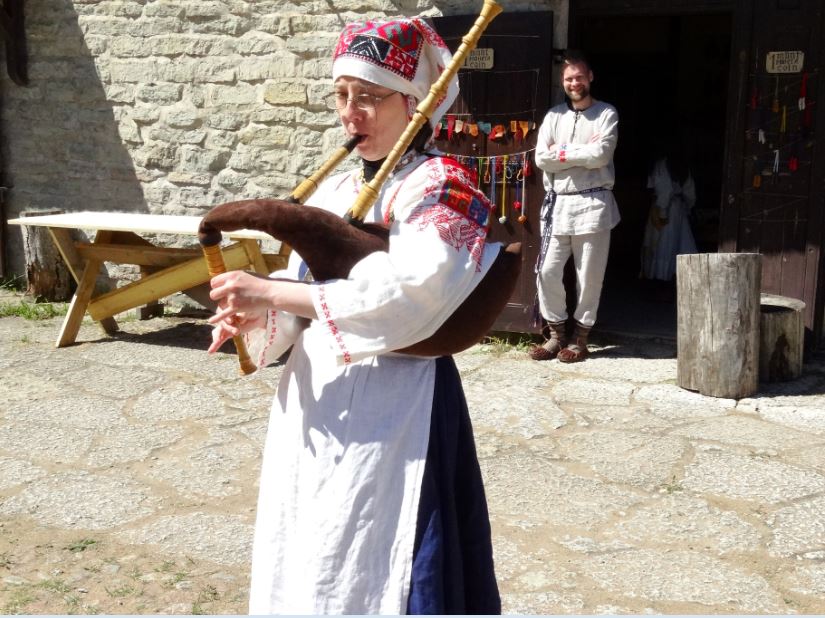
Since 2010, the Kindred Peoples’ Programme has presented the Ilmapuu Award to recognise individuals whose civic initiatives have contributed to the preservation of the cultural identity of Finno-Ugric peoples. This year, the award went to two Finno-Ugric activists living in Estonia—Ekaterina Kuznetsova, a Vote, and Nikolai Kuznetsov, a Komi.
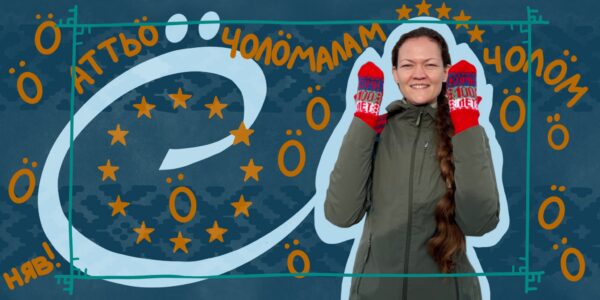
Ekaterina Kuznetsova
Ekaterina Kuznetsova is recognized for her courage and perseverance in shaping Votic (and, more broadly, Ingrian) identity and in embracing her Votic heritage, despite the fact that local authorities in Russia tend to oppose it. Since last year, she has also been a member of the delegation of Russian democratic forces to the Parliamentary Assembly of the Council of Europe (PACE). Through this, she seeks to draw public attention to the Votes, Izhorians, and other endangered Finno-Ugric peoples living in Russia.
Kuznetsova’s roots lie in the Kaprio (Russian: Kaporje) region, among the Votes of the so-called Mäči area. As early as the 1990s, she founded a folk music ensemble with students of Votic and Izhorian descent studying in St. Petersburg to research and perform local folklore. To the best of her ability, she contributed to the Luuditsa village movement, the organisation of the annual Pädrä Day, and the establishment of the local museum.
In 2005, Kuznetsova was involved in the founding of the Votic Cultural Society and submitted the necessary documents on behalf of the society to have the Votes included in the Russian Federation’s list of indigenous and small-numbered peoples (2008). This helped slow down the construction of the Ust-Luga port and industrial zone right next to Votic villages. Unfortunately, the Votic Cultural Society was closed in 2017 by a decision of the Russian Federation’s Ministry of Justice. Since then, Kuznetsova has continued her work in Estonia, where she is the driving force behind the Narva House of Ingria and a spokesperson for local Baltic-Finnic groups. “Kuznetsova’s work at the Narva House of Ingria reminds us who the indigenous peoples of the region beyond the Narva River are”, says jury member Taisto-Kalevi Raudalainen.
In 2025, Kuznetsova organised the Finno-Ugric Capital of Culture programme in Narva. It was a large-scale event that helped promote the languages and cultures of the Baltic-Finnic peoples in Narva and Estonia as a whole, as well as internationally. “Her drive as the organiser of the Finno-Ugric Capital of Culture will hopefully encourage local decision-makers to create a permanent exhibition on small Baltic-Finnic groups at the Narva Museum, in addition to the activities of the House of Ingria”, Raudalainen hopes.
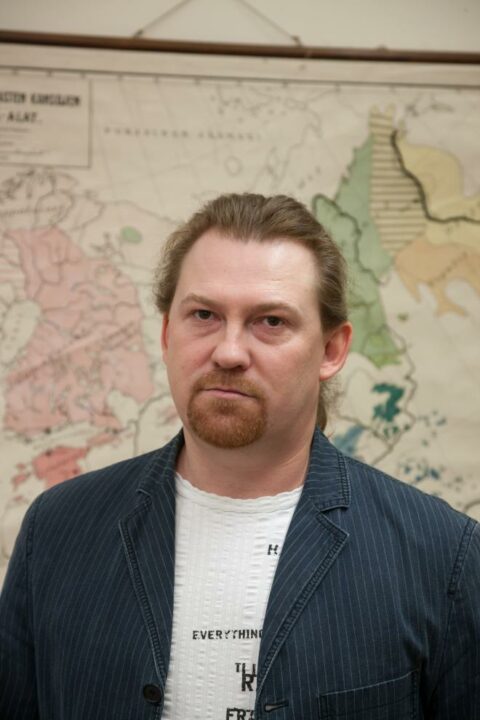
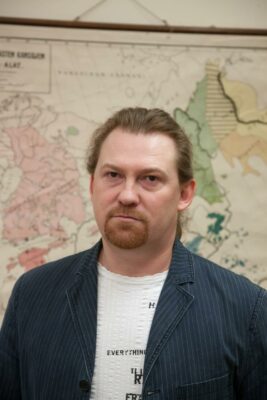
Nikolai Kuznetsov
Nikolay Kuznetsov is being honoured with the Ilmapuu Award for his multifaceted work in documenting, preserving, promoting, and raising awareness of the Komi language and culture. “He has devoted much of his work to issues of Komi folklore, contemporary culture, and identity, combining his research with a cultural mission — he is a shining representative of Komi culture, a serious scholar, and a natural-born teacher who knows how to inspire interest and respect for the Finno-Ugric world in young people”, says jury member Jüri Viikberg in recognition of the laureate.
Through his active involvement, Kuznetsov has contributed to the development and maintenance of ties among Finno-Ugric peoples. For example, together with Sergey Troitskiy, he organised an experimental Finno-Ugric literary café (SUKK) at the Estonian Literary Museum, which centered on a single poem by a particular author and its translations, which the café-goers read and explored together. New translations of the poems emerged from the café and were published as a separate collection in 2024. In this way, SUKK created a unique platform for researching and showcasing the literature of related peoples.
“Kuznetsov is himself a talented translator. He is fluent in Komi, Russian, Estonian, Hungarian, and English. Thanks to his translation work, Estonian readers have access to the research and literature of related peoples”, says Mare Kõiva, senior researcher at the Literary Museum. “His translation of Komi mythology, complete with introductory articles, is in many ways one of the most fundamental guides to Finno-Ugric studies published in Estonian.” In addition, Kuznetsov has translated both contemporary Estonian poetry (by Kristiina Ehin, Aare Pilv, Krista Ojasaar, and others) and poetic classics into the Komi language, while also translating Komi poetry into Estonian. Today, Nikolay Kuznetsov works as a lecturer in Finno-Ugric languages at the University of Tartu and as a senior researcher in the Department of Folklore at the Estonian Literary Museum.