Nina Zaitseva 80
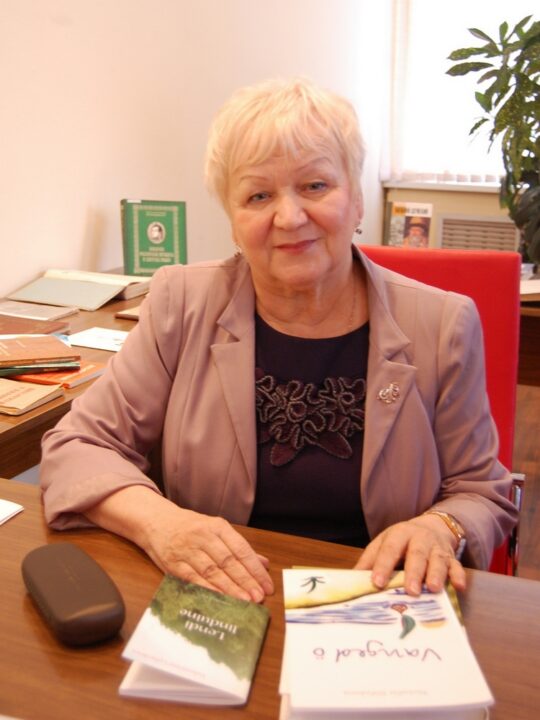
On 25 May, linguist Nina Zaitseva, known as the “mother of the Veps written language”, celebrated her 80th birthday. Nina Zaitseva was born in 1946 in the village of Vyilahti (Voilohta) in the Vologda Oblast. Since she is perhaps the most well-known figure in Veps language and culture, whose contribution to the development of the Veps language and culture has been immense, we are publishing a few questions and answers from various interviews (sources listed below), which also provide insight into the situation of the Veps people today.
Where did your scholarly interest in the Veps language come from?
“I am Veps myself, born in the Babayevo District of the Vologda Oblast. Veps is my native language. I didn’t know Russian until I was five years old. I lost my mother when I was very young, and I was raised by a Russian woman who learned Veps for my sake.
While studying at the Department of Linguistics at the Vologda Pedagogical Institute, I began to think that the Veps language might be a suitable subject for my research. I remember discussing the topic of my term paper—which was related to the language of my home village—with my professor and asking him which language I should write about. The teacher replied: “What kind of question is that? Of course, Russian.” I answered: “But Veps is spoken in the village,” to which he replied that there hadn’t been any Veps for a long time… That was 1965, and that was the prevailing view of the Veps and the Veps culture at the time. However, my favorite professor, Tatyana Panikarovskaya, supported my idea, and I wrote my thesis on the bilingualism of my village. When I graduated cum laude from the institute, Panikarovskaya suggested that I stick with the Veps topic, thinking that perhaps I could do something to preserve my native language. That is how I became a Veps linguist.”
You are the author of the Vepsian dictionary. Please tell us how you compiled it.
“For most of its history, the Veps language has been an oral language. It has not developed as a written language. The spoken Veps language has been recorded thousands of times during various ethnographic expeditions over a long period of time, and these recordings have been preserved. Unfortunately, the Veps language, as it stands today, no longer reflects the realities of the modern world, which in turn requires new words. To create new words, we formed a committee that analyses every new word to be added and also attempts to derive them from existing words. For example, we have enriched the language with scientific terms.”
The Veps epic “Virantanaz”, which you presented, is your own work, compiled using Veps folklore.
“All epics have an author. They come into being when a sufficiently rich body of folkloric material has been gathered and when a need for an epic arises among the people. Then someone appears who gathers it all together. The epic “Virantanaz” is based on Veps laments and incantations, as well as knowledge of the Veps found in ethnographic materials, and of course my own knowledge of Veps life. Through personal experience. The title itself comes from two words: “Vir” is a traditional Veps male name and “Tanaz” is the area where Vir lived and which he left to his people. I chose Aira, a young woman of Saami ethnicity, to be Vir’s wife, because it is known that in the past there was a close connection between the Saami and the Veps. The epic also features secondary characters such as a shaman and a herdsman, who embody the Veps way of life and mindset, which is closely tied to reverence for nature. The period depicted in the epic spans the 15th to 17th centuries. The epic is written in verse, and I hope it will be of interest above all to those who know the Veps language and care about it.”
How would you assess the use of the Veps language in everyday life?
“That’s the hardest question. That’s why we’re trying to expand the use of the Veps language. In Karelia, Veps is constantly heard on the radio and television, and the news is read in Veps. The Veps-language newspaper “Kodima” is published, and books are printed. There are also many opportunities online. I must admit that we have succeeded in raising a whole generation of young people—though not a large one—who actively use the Veps language. There is a conversation club called “Conversations in Veps”, led by my student Larissa Smolina, who began speaking excellent Veps while in college. Working at the university, I see that young people are interested in the Veps language.”
But in reality, there have certainly been very difficult times. I’ve heard people say, “Give up your Karelian and Veps languages”?
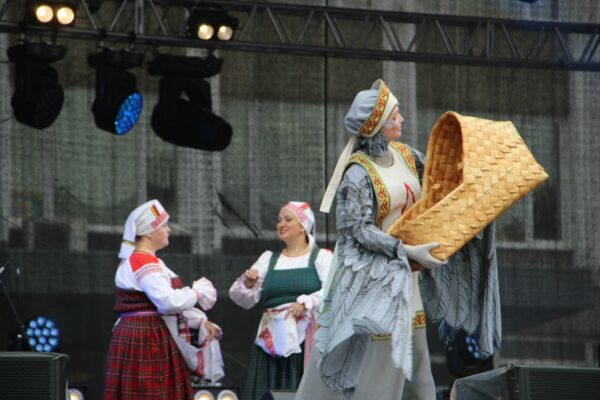
“Yes, that’s how it was, especially in the 1930s. But our family lived in a remote forest village, so we were able to speak Veps. But I remember when my grandfather Grigori Bolshakov, who had been one of the authors of Veps language textbooks in the 1930s, heard that I was going to study the Veps language, he said: ‘Nina, stop! You don’t want your books to be burned someday.’ He recalled with dread the time in 1937 when Veps-language books by “enemies of the people” and “separatists” were burned. You see, this genetic memory persists—the fear that we might one day be punished for speaking Veps. In our village, however, no one actually banned the Veps language. True, when the authorities came, they didn’t speak Veps with us, and we didn’t learn Veps in school either, because Veps wasn’t a subject. We spoke Russian, but at home we were allowed to speak Veps. Today, the Veps have become heavily Russified; they have switched to Russian and sing in Russian. However, fairy tales, lullabies, children’s songs, and lamentations have survived.”
It is true that the Veps language has survived, largely thanks to you, and perhaps also thanks to the translation of the New Testament, for example. However, fewer and fewer people speak Veps. Yet Elias Lönnrot was also wrong when he predicted the imminent disappearance of the Veps people.
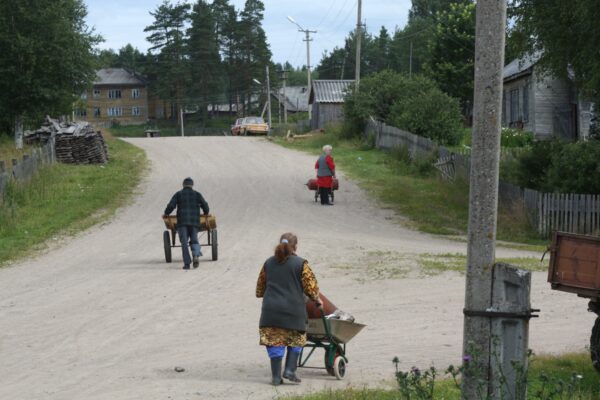
“The language has indeed survived, but the Veps villages where the language thrived are being destroyed. If the so-called ‘optimised’ cultural centres, libraries, schools, and shops in the Vologda and Leningrad Oblasts and in Karelia had not been closed, the villages would still be alive. The Veps would still live there; they would not have wanted to leave, to lose their roots—for that is how a person loses their connection to their people. Who would they speak their native language with in the city? Among the Northern Veps, for example in Karelia and on the shores of Lake Onega, the Veps language has become more Russified. This is because they were the builders of St. Petersburg, the stonemasons. In the 18th century, Veps men went there for seasonal work to earn money. They brought the Russian language and culture with them. The women stayed home to preserve the Veps language and culture, while the men switched to Russian. But elsewhere, for example in the Vologda Oblast, this was not the case. This is Vepsamaa—Karelia, the Lake Onega District, and the Leningrad and Vologda Oblasts. In fact, we are divided into four districts in the Leningrad Oblast and two districts in the Vologda Oblast: Vytegorsk and Babayevo. We, a small ethnic group, have thus been administratively divided into seven parts. And yet, compared to the languages of other small ethnic groups, our language has been well preserved. We have been helped by the university, by people who perhaps did not speak Veps before but learned it well enough and now work in radio, television, and newspapers. They enjoy it.”
Nina Zaitseva is a Veps linguist, folklorist, writer, and translator. She graduated from the Vologda Pedagogical Institute in 1969 and completed her postgraduate studies in 1973. In 1975, she defended her candidate’s dissertation in linguistics, and in 2002, her doctoral dissertation on the topic “The Veps Verb: A Comparative Contrastive Study.” From 1969 to 2022, he worked at the Institute of Linguistics of the Karelian Institute of Language, Literature, and History, where he served as head of the linguistics department from 1997 to 2020. He has written over 200 scholarly articles. Together with Irma Mullonen, she developed the foundations of the Veps written language and is the author of the Veps alphabet, which was adopted in 1989.
In 2012, she wrote the Veps epic “Virantanaz,” which has been translated into Estonian twice by Madis Arukask and Jaan Õispuu.
Nina Zaitseva is the author, along with co-authors, of 19 Veps-language textbooks; it was on her initiative that the teaching of the Veps language began in schools. In addition, she has translated both the Children’s Bible and the New Testament into Veps, as well as the “Kalevala.” She is the author of several Veps dictionaries and numerous works of fiction, serves on the editorial boards of several Veps-language journals, and teaches Veps language courses at Petrozavodsk University, which she has also developed herself. Zaitseva has served as editor for all Veps-language literary publications.