The Mari and Finnougristics
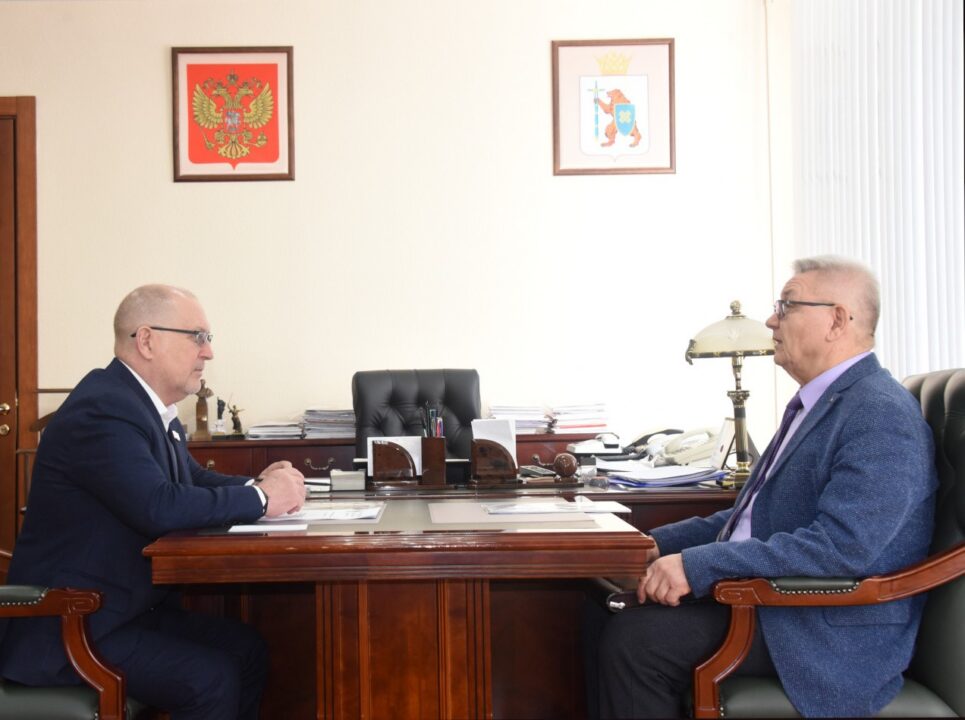
On 13 March, Mikhail Vasyutin, Speaker of the Parliament of the Republic of Mari El, met with Oleg Sergeyev, Chairman of the Committee on Finnougristics of the Russian Federation and a Mari linguist. The meeting focused on the development of Finno-Ugric studies, as well as the participation of a delegation from the Republic of Mari El in an international forum at St. Petersburg State University.
Linguistics conference
The 54th International Conference of Linguists named after L. A. Verbitskaya took place at St. Petersburg State University on 24–26 March. A Uralic Studies section was organised as part of the conference. The section addressed current issues regarding the development, status, and teaching of Uralic languages and was dedicated to the 55th anniversary of the Committee on Finnougricists of the Russian Federation. In connection with the anniversary, a roundtable discussion titled “Finn-Ugric Studies in Russia Today: Traditions and Development” also took place. The Mari Institute of History, Language, and Literature and Mari State University participated in the conference and roundtable.
Committee on Finnougristics
Oleg Sergeyev raised the issue of expanding the committee’s membership: currently, it comprises six departments (Khanty-Mansi, Karelian, Komi, Mari, Mordvin, and Udmurt), but there is a desire to establish Perm Krai and Komi-Permyak departments, as well as to bring in younger researchers from St. Petersburg and Moscow.
Mikhail Vasyutin emphasised the necessity of preserving and studying the native language during the meeting.
The Mari language
At the same time, the situation regarding the teaching of the Mari language is critical. The number of students learning Mari as their native language in the Republic of Mari El has decreased more than tenfold, accounting for 3–4% of the total student population. On average, Mari is taught for one to two hours per week, and studying the language is optional.
According to the 2020/21 Russian Federation census, nearly 260,000 people speak the language; in 2010, there were over 360,000 such people. Over the course of a decade, the number of Mari speakers decreased by 100,000. Nevertheless, over 79% of Mari people considered Mari their native language, which is the highest rate compared to all other Finno-Ugric peoples in the Russian Federation. This is primarily due to the fact that the majority of Mari people continue to live in compact rural areas, as well as the fact that the Mari have largely preserved their culture, including their nature-based religion.