Komi Republic plagued by economic and environmental problems

News from the Komi Republic in April and May have pointed to a steadily deteriorating economic situation in the republic, as well as increasingly widespread environmental pollution.
Economic problems
In April, and even earlier, reports emerged of the dire situation in the forestry industry, as timber exports are not proceeding at the planned volume according to industry estimates, which has pushed several companies to the brink of bankruptcy. In connection with this, criminal cases have been initiated; for example, the manager of one factory has owed employees wages for more than two months and paid them less than the minimum wage. The factory’s management has used the funds received in the interests of production: an anonymous court case suggests that the company’s manager has attempted to resolve the situation without sparing the employees, which constitutes a violation of the law in Russia, as wages must be paid first. Of course, the court case does not clarify the reasons why the forestry industry is in a difficult situation.
A difficult situation has also arisen in Vorkuta, which was recently visited by Dmitry Bratynenko, the head of the republic’s government. Namely, the entire Russian coal industry is in trouble, but especially the coal mines in the Vorkuta area, such as the company “VorkutaUgol”. Mining volumes have decreased, coal export revenues have fallen sharply, while costs have risen. “How to protect local residents in this situation and find alternative jobs for former miners is the main issue right now. At the same time, however, the company must be preserved, employees protected, and production quickly resumed once the situation improves”, noted Bratynenko.
Environmental problems
Oil spills have been discovered in several parts of the republic, such as Ukhta and Pechora; oil has flowed into rivers, canals, and swamps. Global warming has been cited as the main reason for the increase in oil spills; for example, in Syktyvkar, the air temperature on May 16 was +29°C. Climate warming has led to the melting of permafrost, which in turn causes the subsidence of pipeline support structures. Oil pipelines installed 30–40 years ago cannot withstand this because their fastenings have rusted through.
Consequences for demographics
As economic problems in Komi have become increasingly severe, this has been accompanied by a significant outflow of the population. While the population of the Komi Republic was 901,189 in 2010, it stood at 714,785 in 2025: over the past 15 years, the population has decreased by nearly 200,000 people. Consequently, the proportion of Komi people in the republic’s population has increased, as migrants who came in search of good wages either return home or move to large cities, while the Komi people mostly remain, although emigration is also evident among them.
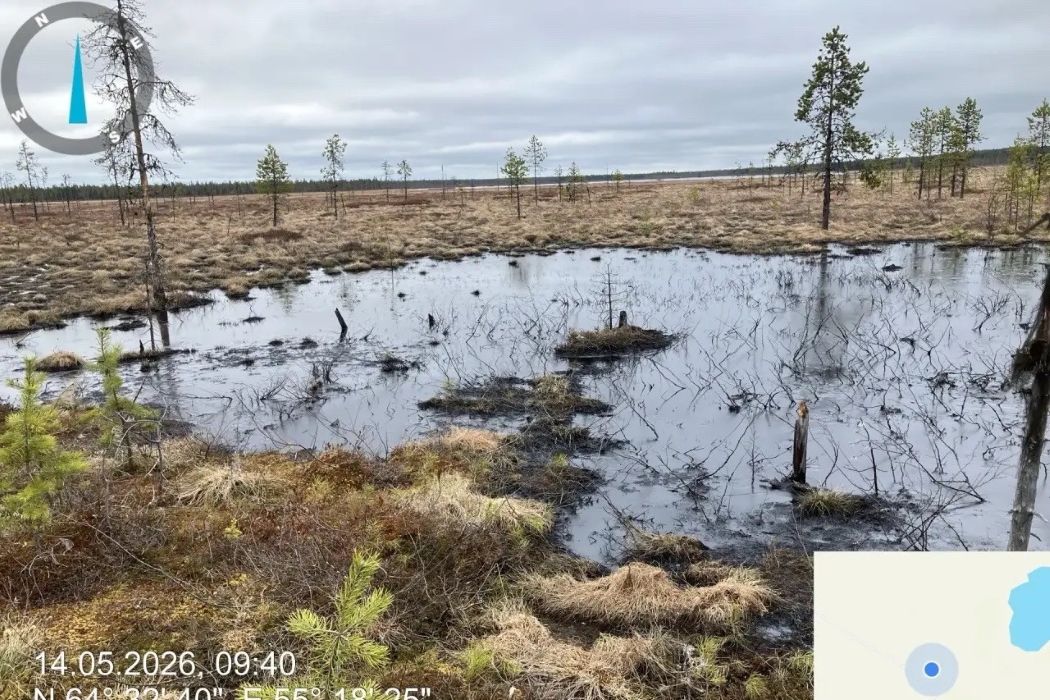
- В Печорском районе устраняют последствия разлива нефтепродуктов (15.05.2026 Komi Inform, in Russian)
- Погода в Коми 16 мая: аномально жарко (15.05.2026 Komi Inform, in Russian)
- “Правительство Коми не оставит людей” — Дмитрий Братыненко поручил взять под защиту сотрудников “ВоркутаУголь” (16.05.2026 Komi Inform, in Russian)
- В Усинске ликвидируют последствия нефтеразлива (19.05.2026 BezFormata, in Russian)
- Директор лесозаготовительной компании в Сыктывкаре пойдёт под суд за долги по зарплате (20.05.2026 Komi Inform, in Russian)