Siberian Mari language and culture may die out
Researchers are concerned about the decline of the Mari language in the Sverdlovsk Oblast, where the Mari population has fallen by 40 per cent over the past ten years and half of those of Mari ethnicity no longer speak the language. Linguist Marina Kutsayeva writes about this in the Tomsk Journal of Linguistic and Anthropological Studies.
Marina Kutsayeva writes about the findings of the 2025 expedition, during which a total of 190 people of various ages were surveyed. The survey revealed that the Mari language is currently disappearing even within families who consider themselves to be of purely Mari ethnicity. The language is used on a daily basis by the older generation and those slightly younger, but unfortunately young people and children do not speak the language. There is a clear trend for young people to move to the cities, but by that time they have already switched to Russian. In the author’s view, the reason for this is that, due to the low prestige of the Mari language, parents have spoken to their children in Russian. Unfortunately, parents believe that the language is an obstacle to their children’s success at school.
Assimilation of Mari
As the Mari population has declined, many Mari villages have been abandoned or are now home only to elderly residents. In the three Mari-populated districts of the Sverdlovsk Oblast, only two under-enrolled schools remain, where a total of 48 pupils in Years 1–3 study the Mari language as an optional subject, and teachers fear that these schools too will soon be closed. In 2025, the last nursery school in the Sverdlovsk Oblast where the Mari language was taught was closed.
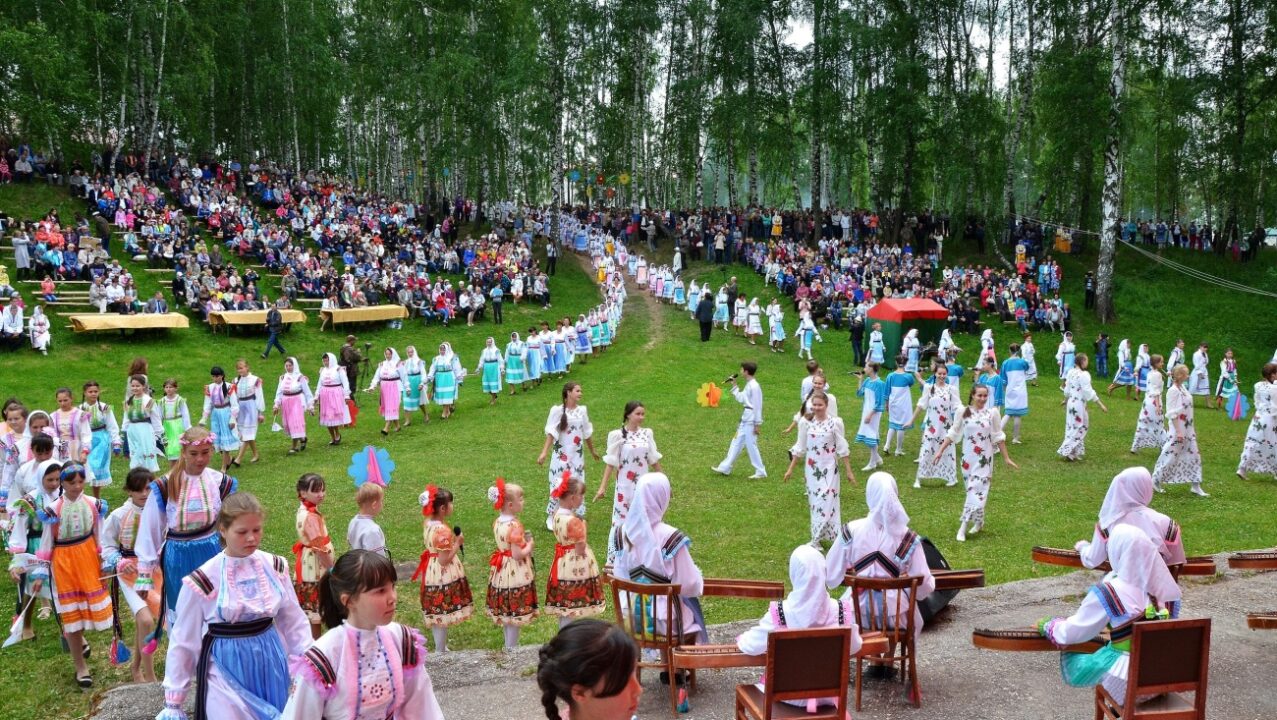
The use of the Mari language is also changing rapidly in the cultural sphere; a few folklore ensembles meet at cultural centres, but only older people take part in them. The repertoire is increasingly bilingual (Mari and Russian), as the groups perform in towns and cities with mixed populations. The content of the repertoire has also changed: pop music is increasingly replacing the old local folk songs. In cultural centres, where specialists proficient in Mari used to work, staff with a poor command of the language are now employed, which in turn means that the workforce has become Russian-speaking.
Theatre performances in Mari have also practically ceased, as there is no demand for them. To a certain extent, Mari dances have survived. Nevertheless, village libraries, as well as cultural centres and schools, take part in nationwide initiatives to introduce the Mari language and culture, read poetry and hold recitals. Recently, traditional Mari folk costumes have gained popularity, and activists hope that this will spark greater interest in the language and culture as well. At the same time, however, there is also a view that a folk costume without the language is merely a masquerade.
Uncertain future of Mari language
In conclusion, based on data from fieldwork, the author concludes that, despite the Mari language still being used in a number of areas, the linguistic and cultural heritage of the Mari people is in a vulnerable state: its spheres of use are gradually narrowing, intergenerational transmission is extremely weak, the number of inter-ethnic marriages is increasing, and language shift is gaining momentum.
There is a widespread belief amongst community members, particularly the older generation, that the language ‘will die out when we are gone’: this is due to the general ageing of the population, the exodus of young people to the cities, and the fact that their children and grandchildren do not speak Mari. At the same time, many respondents regard the national language as a key marker of ethnic identity, which is necessary for the preservation of the Uralic Mari people. The author argues that, in such a situation, the revitalisation of the language is crucial, and that the preservation of linguistic diversity requires the constant attention of key figures at federal, regional and local levels.
According to the 2020/2021 census, there were 13,988 people of Mari ethnicity living in the oblast, although the 1989 census had recorded 31,297 Mari people.