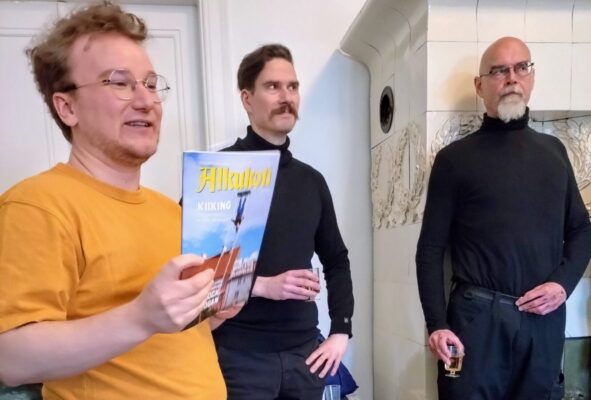
Members of Hõimulõimed at IFUSCO
The International Finno-Ugric Student Conference (IFUSCO) took place at the University of Helsinki from 11–15 May. This is an annual event that brings together students, activists, and young researchers interested in Uralic languages and peoples. This year marked the 41st time that IFUSCO was organised, with approximately 140 participants, most of whom attended in person.
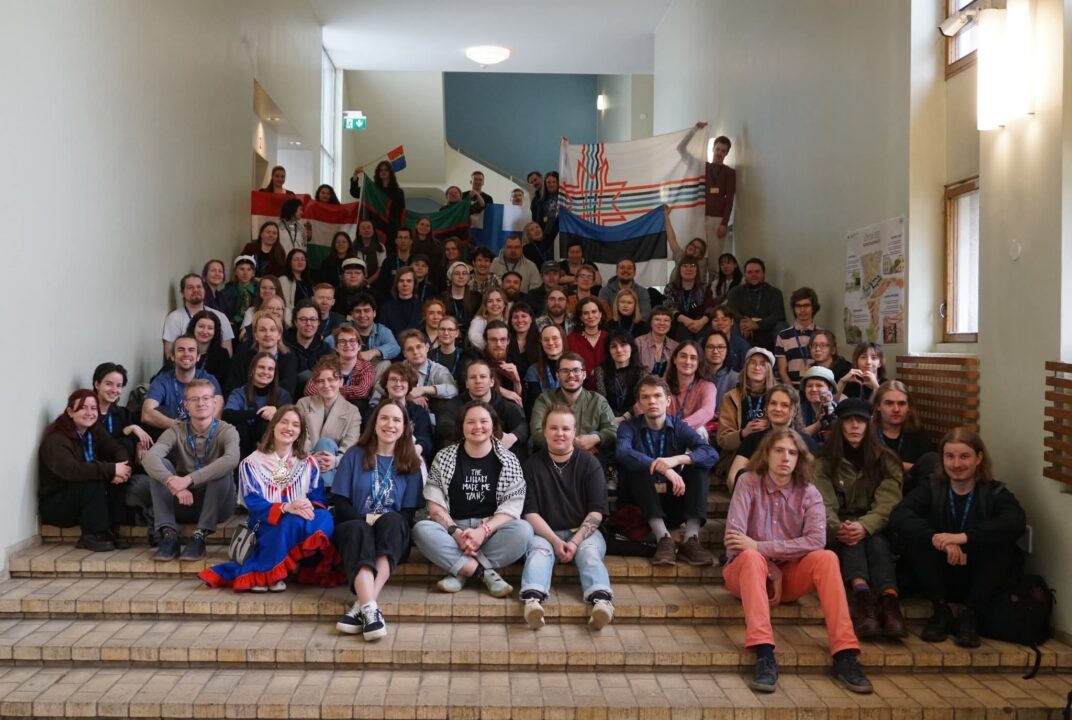
Members of Hõimulõimed contributed to the conference with a wide range of topics: Britt-Kathleen Mere spoke about resources for minority languages in the context of language technology, Bridge Moran-Nae introduced the role of Livonian musicians in language revitalization, Mirjami Sipilä compared Finnish and Komi folk poetry, Riku Pihkakoski spoke about the dialect collections of Saareste and Kettunen, and Atte Huhtala’s literary overview of “Ugric empathy” brought the conference to a close before the closing ceremony. In between the research presentations, there was a film session featuring films from the Finno-Ugric Film Festival (FUFF), organised by Bogáta Timár.
An integral part of IFUSCO is the evening programme. On the Ugric-Mugric evening, members of Hõimulõimed—Atte, Mirjami, Bridge, Bogáta, and Britt—took the stage, performing, among other things, a medley of American-Finnish songs and “Rukkilõikus” in several Baltic-Finnic languages. The evening was spent singing well-known Finno-Ugric songs and playing circle games, and ended with Komi heavy metal.
The traditional dinner followed Finnish student traditions (sitsit), which was a first-time experience for many. Randomly assigned seating and quickly breaking the ice with group singing led to many new acquaintances that might not have happened otherwise. The group singing culminated in a performance of the “Saaremaa Waltz” on stage.
Naturally, countless fascinating conversations took place during coffee breaks, in the cafeteria line, on the hostel benches, and on the night buses home. Although representation from the Uralic peoples within the territory of the Russian Federation was low for obvious reasons, the discussions among participants were, in their estimation, as rich as ever.
The recurring theme of the conversations was the host of the next IFUSCO—traditionally, representatives from universities wishing to host the event give their presentations, and conference participants then vote. This time, the University of Tartu and the University of Szeged competed for the right to host the event; both had been preparing for several months and had their logos ready.
As a result of the vote held during the closing ceremony, the University of Tartu was selected as the host of IFUSCO 2027; the university last hosted IFUSCO in 2018.