Sings in Izhorian create scandal in Russia
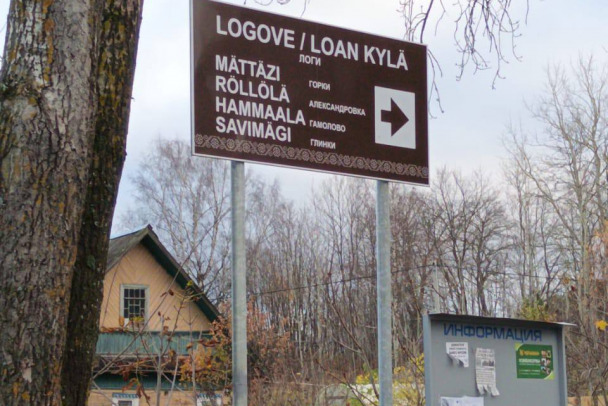
After six years of work, village signs in the Izhorian language using Latin letters were installed in the Leningrad Oblast. Half a hundred village signs were placed in the territory of the Vistina (Вистино) village council, with the Izhorian language alongside Russian. The signs were placed not only in the current Izhorian villages, but also in places where Izhorians used to live more densely.
The day chosen for the unveiling of the new plaques was originally the Day of the Burned Villages, which has been commemmorated in the Leningrad Oblast for ten years on 29 October. In reality, the unveiling took place on 4 November, which is National Unity Day in the Russian Federation.
The Izhorian language is written using Latin letters. Thus, the village of Слободка is Säädinä on the sign, Залесье is Metsäkylä, Логи is Logove/Loan kylä, Александровка is called Röllölä. Now tourists can learn that Вистино is also called Vistina, Суйда is Suija, Югантово is Saarove, and Сменково is Otstave.
Local reception
The local news portal 47news described the event in rather positive terms, noting that it was organized on the initiative of the Izhorian community in Shoikkula and with the support of the Kingissepp district administration. The portal’s sources considered it possible that the Izhorian initiative could also be implemented in other parts of the oblast where indigenous peoples live, such as among the Veps.
Šoikkula leader Dmitri Harakka-Zaitsev told reporters that it took a long time to implement the idea. The first Izhorian language signs were installed in villages in 2016, but they were vandalised. “In 2019, which was declared the Year of Indigenous Peoples by the UN, we decided to revisit the issue in order to give more weight to the small Izhorian language”, he said. Linguists, local indigenous people, and local historians joined the initiative, and Harakka-Zaitsev said that the results are satisfactory. “The Izhorian language and ornaments are clearly visible and are an important addition to tourist routes throughout the Shoikkula Peninsula. It is part of the national color of the Leningrad Oblast,” he noted.
According to the 2024 publication Национально-культурные общественные организации, действующие на территории Ленинградской области (National-Cultural Public Organisations Operating in the Leningrad Region), there are 169 Izhorians living in the Leningrad Region, which constitutes 0.01% of the region’s population. Seventy people speak the Izhorian language.
Russian backlash
This very necessary and welcome initiative by the Izhorian community, which at first glance appears to be small in number, as well as the support shown by the authorities, could be classified as one of the few pieces of positive news in the field of ethnic policy in the Russian Federation, had it not been for the reaction that brought out the nature of Russian chauvinism and other phobias.
A week later, on 17 November, the portal versia.ru published an article titled “Is the Leningrad Oblast preparing for a parade of sovereignty?” The article discusses how, with the support of local authorities, signs written in the Izhorian language, which is incomprehensible to local people, have appeared on a brown background. It asks whether the local authorities have really thought this through. However, the Izhorian language is written in quotation marks, which means that the journalist probably does not consider it a language.
The journalist continues that the signs have appeared in an area that could be considered strategic, as the peninsula is located near Ust-Luga, the largest port in the Baltic Sea. The article states that as of 2010, there were 123 speakers of the Izhorian language and notes that there are 210 such speakers in the entire Russian Federation. The journalist believes that small nations do indeed need support, but that these nations themselves do not always want such attention.
For example, this was the case with the Ingrian Finns, when in the 1990s the notorious movement “Free Ingria” called for autonomy and even the separation of the Leningrad Oblast from Russia, wishing for the collapse of Russia altogether. A few years ago, Susanna Parkkinen, a local Ingrian activist, noted that the leaders of the separatist movement “Free Ingria” were not Ingrians at all, but “self-appointed” individuals who were hiding behind the Ingrian identity.
Thus, it cannot be apparently ruled out that terrorists will emerge who present themselves as Izhorians or Votes. “It is worth noting that ‘Free Ingria’ already welcomed the renaming of villages in the Izhorian language. Could it be otherwise?” writes journalist Venyamin Solodov. He continues the topic by referring to President Vladimir Putin, who noted at a meeting of the Council for Ethnic Relations on 5 November that international organisations and pseudo-ethnic centres are being created outside Russia, and that this is actually an information war against Russia: there is talk of some kind of “decolonisation” of Russia.
Fear of indigenous minorities
The journalist concludes the article with the observation that it turns out that “pseudo-ethnic” centers are being created abroad, but the groundwork for their activities is being laid locally. Commenting on the article, historian Aleksandr Dyukov said that, in his opinion, the construction of the Republic of Ingria has already begun. One example of this is the creation of symbols that say, “Look, this is not Russian land.”
Publicist Aleksei Zhivov, however, finds with some regret that since Russia respects international law, this gives the enemy the right to appeal to the UN-recognised “right of peoples to self-determination” and warns that this is how the Soviet Union collapsed in its time.
A few days later, on 19 November, journalist Ivan Dmitriev wrote an article titled “The UN Against Russia” on the versia.ru portal, in which he drew attention to the leading universities of the Russian Federation that train specialists in the field of international law. Namely, the Ural State Law University held a summer school dedicated to human rights. There were about a hundred students who had to participate in a mock trial game called “The Inguarani Family v. the State of Sigma.”
The authorities of this fictional country allegedly deported several villages located near precious metal mines, where the indigenous “Pilar” tribe lived in close proximity. One team defended the legal interests of the indigenous people and argued that Sigma had violated their rights, using active international documentation such as the UN Declaration on the Rights of Indigenous Peoples, documents from the UN Indigenous Peoples’ Forum, etc. Sigma’s representatives, however, had to argue that they were following the national development program, that there were support measures in place for the residents of the deported villages, as well as other documents developed by the Sigma government.
In short, international law competed with national legal norms. The defenders of the indigenous peoples’ pillars emerged victorious, with Dmitri Harakka-Zaitsev, leader of the Izhorian community, acting as expert. The journalist asks whether it is possible that Russian universities are training future lawyers who will defend the “rights of indigenous peoples” by attacking Russian companies, regardless of whether these peoples want their rights to be defended or not.
The author gives a cautionary example from Brazil, where indigenous peoples gathered at the accreditation zone of the 30th UN Climate Change Conference in Belém to protest against the drilling of oil wells on their territory. One of their leaders said: “We want our lands to be free from agriculture, oil production, and forestry.”
Developing scandal
The scandal surrounding the Izhorians and Dmitri Harakka-Zaitsev is still gaining momentum, and his actions are featured on the very popular Russian TV show Бесогон (The Uprooter of Evil), hosted by famous film director Nikita Mikhalkov. On 11 December, the portal myseldon.com published an overview of the program entitled “Estonian agent and accomplice exposed,” revealing who Dmitri Harakka-Zaitsev really is. Viewers learn that Harakka-Zaitsev is a candidate of legal sciences who, in his thesis, accused the Soviet Union of genocide against the Izhorians and of depriving the Ingrians of their social, economic, and cultural rights. In addition, he has appealed to Estonia to protect the Izhorians from the Russians. Mikhalkov notes that this is a gift to the European Union, which is imposing sanctions against us. “The people of our country are turning to the West to protect them from their own country,” says Mikhalkov.
- К чему эти скандинавские Ä и Ö? В Ленобласти появились указатели на ижорском (47news.ru 07.11.2025, in Russian)
- К чему эти скандинавские Ä и Ö? В Ленобласти появились указатели на вымирающем языке (Fontanka.ru 07.11.2025, in Russian)
- ООН против России (Versia.ru 16.11.2025, in Russian)
- Притянуть бы за язык (Versia.ru 17.11.2025, in Russian)
- Агент – пособник Эстонии разоблачён: Михалков вскрыл детали (Myseldon.com 11.12.2025, in Russian)