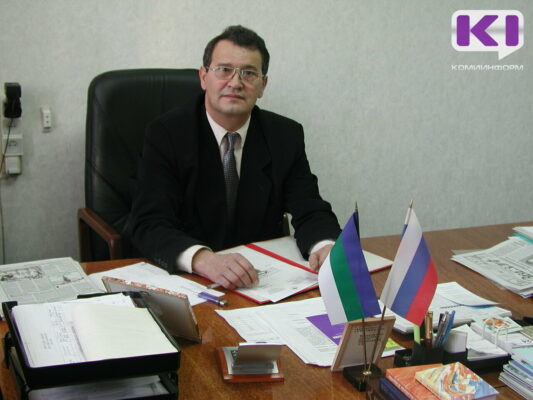
In memoriam Yury Lisovski (1964-2026)
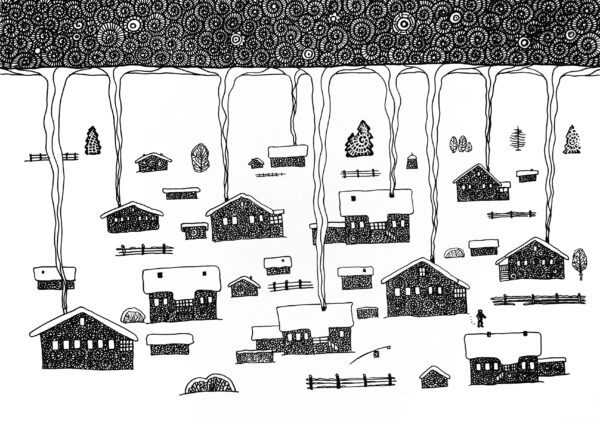
The international Finno-Ugric community has been deeply saddened by the news that the outstanding Komi ethnofuturist artist Yury Lisovski has passed away (11 April 1964 – 16 January 2026).
Yuri’s fate was unique. At the age of 14, he left his homeland of Ukraine. He studied to become a riverboat captain in Komi Republic, where he met a beautiful Komi girl. He got married and started a family. He learned the Komi language and said that his children were Komi. He then enrolled in the Syktyvkar Art School, graduating in 1990.
Together with his friend, Komi artist Pavel Mikushev, they went on expeditions to Komi hunting grounds and villages, thus establishing a connection with the indigenous Komi religion, mythology, and sign system. This became the basis for their art. Together, they also illustrated a scientific publication on Komi mythology.
Nature and Permic animal style
Yury Lisovski’s works often contain symbols. He said: “Much is created on the basis of memories. In my childhood, I went to the forest with my mother and we got caught in a thunderstorm. We hid under a tree whose branches swayed and waved as if a bird were flying. My mother said, ‘Look, the tree is waving its branches like a bird.’ That stuck in my memory, and I drew a bird symbolising the earth, with us flying above it.”
In 1992, Lisovski performed at the Congress of Finno-Ugric Youth Associations in Izhkar (Izhevsk) in Udmurtia, together with other ethnofuturists. This inspired him to continue his creative work, in which he used not only Komi mythology but also the ancient Permic “animal style”.
At first, he was not taken seriously and was not accepted into the Russian Artists’ Union. When he presented his ethno-futuristic triptych “Morning-Noon-Evening” to the commission, they commented: “Young man, you must be joking.”
Ethnofuturism
In May 1994, the first conference of Finno-Ugric young artists was held in Tartu, organised by the Fenno-Ugria Tartu Centre under the leadership of Kauksi Ülle. Kauksi Ülle recalls that young artists from Komi also wanted to come to Tartu and were willing to cover the costs themselves. When the train, which at that time ran directly from Moscow to Tartu, arrived, the first things to be unloaded were large paintings in vivid colors, behind which the artists were not immediately visible.
“This is how the Komi ethnofuturist artists arrived in Tartu. We hung the large paintings in the conference hall and immediately exempted the artists from the participation fee,” recalls Kauksi Ülle. After the conference, the artists donated their paintings to the Estonian Kostabi Society, and they can still be seen from time to time at events introducing Finno-Ugric peoples.
Kauksi Ülle remembers Yury Lisovski first and foremost for his open smile and cheerful disposition. Although he loaded wagons to support his family and remain an artist, he was happy that he could do so. In Komi, he welcomed the creators of Estonia and other Finno-Ugric peoples very hospitably — they called each other “sisters and brothers.”
Exhibitions held in Estonia and the creation of the ethnofuturist school paved the way for artists from kindred peoples to become representatives of their republics. Lisovski’s fame and significance in Komi also gradually grew. He organised numerous exhibitions and received commissions for designing bank cards and decorating large representative spaces, among other things. He became the artist of the Komi cultural magazine “Art”. He also designed the symbols for the 90th anniversary of the Komi Republic (2011).
Estonian connection
Lisovski visited Estonia repeatedly. In 1999, he took part in an art camp for Finno-Ugric artists in Piirissaare and Kütioru. In 2008, Lisovski exhibited his work at the KUMU exhibition “North and South: Continental Subconscious. Contemporary Art and the Finno-Ugric World”.
Yury Lisovski’s works can also be seen at the Estonian National Museum’s permanent exhibition “Echo of the Urals.”
In 2015, Obinitsa, the Finno-Ugric Capital of Culture, hosted an ethnofuturism conference called “The Creator Comes to Visit”. Yury Lisovski conducted an ethnofuturistic drawing workshop for all participants, teaching them to draw their own worldview. He also worked at the Komi Art School and held workshops elsewhere. Less well known is that Yury Lisovski was also a photographer, philosopher and inventor. He had dozens of patents for various devices, primarily related to human safety issues.
Kauksi Ülle recalls that his last meeting with Yury Lisovsky was at an ethnofuturism seminar in Komi in 2016. There, too, they talked and exchanged news: Yury talked about how much joy he was getting from building his own house. He said that everything in life should be done with joy.
Finally
It is safe to assume that the last few years were not easy for Yury Lisovski.
The great painter, artist, art teacher, soul of the national movement, and philosopher has completed his work. It is very sad that illness showed no mercy and took the colours from his talented hands too soon, taking one of the brightest souls of our movement from us into eternity.
Deepest condolences to Yury’s family and loved ones, and to the entire Komi people.
Fenno-Ugria Foundation
- Умер известный художник-этнофутурист Юрий Лисовский (KomiInform 16.01.2026, in Russian)
- Artist draws inspiration from Komi mythology (16.12.2023)
- Лисовский Юрий Николаевич (Sever Art of the Nations, in Russian)
- Лисовский Юрий Николаевич (emvacbs.ru, in Russian)
- Põhi ja kirre: kontinentaalne alateadvus. Kaasaegne kunst ja soome-ugri maailm (KUMU 2008, in Estonian)
- Юрий Лисовский. Вне времени и пространства (Region 02.02.2022, in Russian)