First Komi People’s Congress 35 years ago
On 11-12 January 1991, the first Komi People’s Congress was held. The Congress was attended by over 400 delegates and guests from all cities and districts of the republic. Also, representatives of the Komi people from the Murmansk, Arkhangelsk, and Tyumen oblasts, the Nenets and Komi-Permyak autonomous districts, the republics of Mari El and Udmurtia, and Moscow were present.
The Komi people were congratulated on the anniversary of the congress by the head of the Komi central organisation Komi Voityr, Oleg Lazhanev, who noted that over time, the Komi social movement has become a symbol of co-operation between state structures and the people.
“We are proud that thanks to the Komi activists who were and still are involved in the movement, great work has been done for the benefit of the republic,” said Lazhanev.
“These days, we remember with gratitude the initiators of the movement who put all their strength and soul into the development of Komi Voityr. Gennady Yushkov, Vitaly Ossipov, Alexander Popov, Vladimir Timin, Valery Markov. Their ideas and aspirations inspire us to new achievements,” said Lazhanev.
Anniversary roundtable
As has become customary in recent years, it is no longer considered necessary or even possible to celebrate the anniversaries of national movements and national organisations in the republics of the Russian Federation. This is particularly noticeable in the case of socio-political organisations that sought to defend the rights of nationalities in the late 1980s and early 1990s. It is not considered necessary to recall the demands of the peoples belonging to the Russian Federation at that time for sovereignty, restrictions on migration, self-government, a bicameral parliament, education in their native languages, etc.
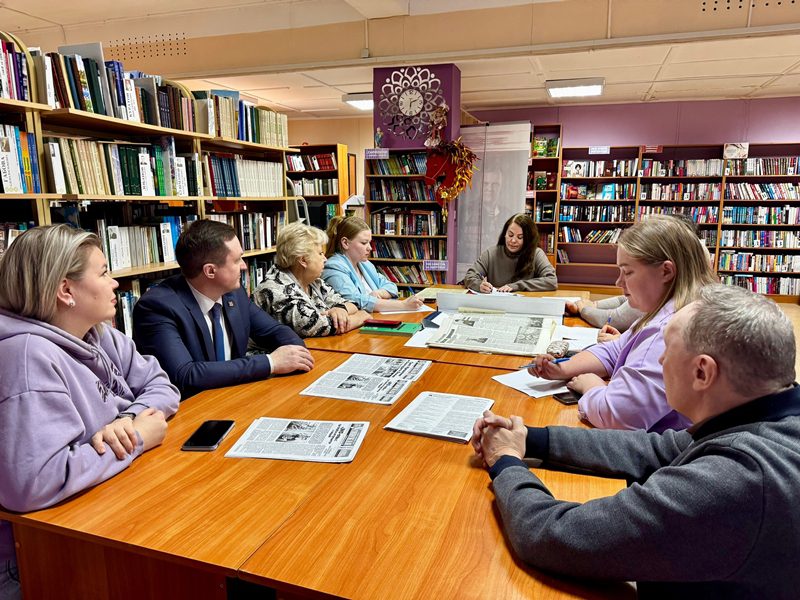
This year, the same was done in the Komi Republic, where the main anniversary event took place in the central library of the city of Ussinsk, located nearly 800 kilometers from the capital Syktyvkar: a roundtable discussion dedicated to the 35th anniversary of the Congress, “Komi Voityr: 35 Years of History.” The roundtable was attended primarily by local Komi Voityr activists.
Key themes
The roundtable discussed the significance of the first congress, how it changed the self-awareness of the people, gave impetus to the development of the national movement, and influenced legislation concerning the protection of indigenous peoples. The oldest members of the roundtable recalled the activities of the national movement in the Ussinsk district, which concerned the preservation of the Komi language and traditions both in the countryside and among the urban population.
The connection between generations was considered important: how the ideas that emerged 35 years ago live on today and what the tasks of today’s youth are. It was agreed that the fate of the Komi language, which was central to the first congress, remains so today. The library hosted a thematic exhibition, primarily featuring excerpts from newspapers covering the first congress. Among the exhibits was the book of memoirs by Valery Markov, the first chairman of the Komi People’s Rebirth Committee elected at the first congress, entitled “Rebirth in a Time of Change.” Anastasia Gilmanova, head of the local Komi Voityr department, noted at the meeting that it is important to remember history in order to build the future.
First Komi People’s Congress
The Komi were the first in the Russian Federation to organise their own people’s congress.
In 1991, the congress adopted five resolutions: on the state sovereignty of the Komi ASSR, on national policy in the field of language and culture, on the socio-economic development of the Komi ASSR, on environmental protection, and on measures to protect the rights and interests of workers in a market economy.
Resolution of the congress
The most important document was the resolution on the sovereignty of the Komi ASSR, which supported the Komi ASSR’s declaration of sovereignty. According to this, the bearer of sovereignty is the people of the Komi ASSR, which has historically emerged on its territory. Sovereignty is expressed by its highest state authority, the Supreme Soviet of the Komi ASSR, which consists of two chambers, the Chamber of the Republic and the Chamber of the Komi People. The Congress is in favor of economic and national cultural integration with the Perm-Komi Autonomous District, as well as the development of comprehensive contacts with the Finno-Ugric peoples.
The resolution on the socio-economic situation found that the standard of living of the Komi people did not correspond to the good economic situation of the Komi ASSR, as Komi had rich natural resources that should be declared the property of the Komi ASSR. The resolution on national policy in the field of language and culture stated that the Komi and Russian languages should be declared the official languages of the state and for use in state institutions. The Komi national school should be restored. The resolution on the environment proposed closing the Novaya Zemlya nuclear test site. The congress banned unauthorised logging on the territory of the republic and supported the residents of the Pechora River in saving the Pechora River.
Significance for the Komi
A very important document of the congress was the decision to form an executive body of the congress, or the Komi People’s Rebirth Committee, to coordinate the social movement.
The congress documentation determined the ideology of the Komi national movement for many years to come. The congress not only influenced the national ideology of the Komi people, but also had an impact on the national movements of other Finno-Ugric and other peoples belonging to the federation — the Komi were the first.