
Hancock 2026
The 2026 Finno-Ugric Capital of Culture is Hancock, Michigan, USA.
Hancock, Michigan
Hancock is a town of 4,500 people located in what is known as the Upper Peninsula of Michigan in Houghton County. Originally located in Ojibwa (Chippewa) homelands, the territory was established by the Treaty of 1842. The founding of the village of Hancock began in 1847, centred around copper mining. The village was named after John Hancock, a signer of the US Declaration of Independence. On 10 March 1863, the village was officially organised and this is considered the founding date of Hancock.

Hancock is known as the capital of Finnish American culture. It is home to the Finnish American Heritage Center, the Finnish American Folk School, and the Finnish American Reporter newspaper.
The first pastor to serve the Finnish American community, Alfred Elieser Backman, came to Hancock in 1876. By 1889, four pastors from the Church of Finland were serving Finnish communities in the Upper Peninsula. These pastors eventually convened to form the Suomi Synod on 25 March 1890, which existed until 1962.
The president of Suomi Synod, Juho Kustaa Nikander founded Suomi College (full name: Suomi Opisto (Finnish College) and Theological Seminary) in 1896. The college’s role was to preserve Finnish culture, train Lutheran ministers and teach English. On 1 July 2000, Suomi College changed its name to Finlandia University. The university closed in 2023.
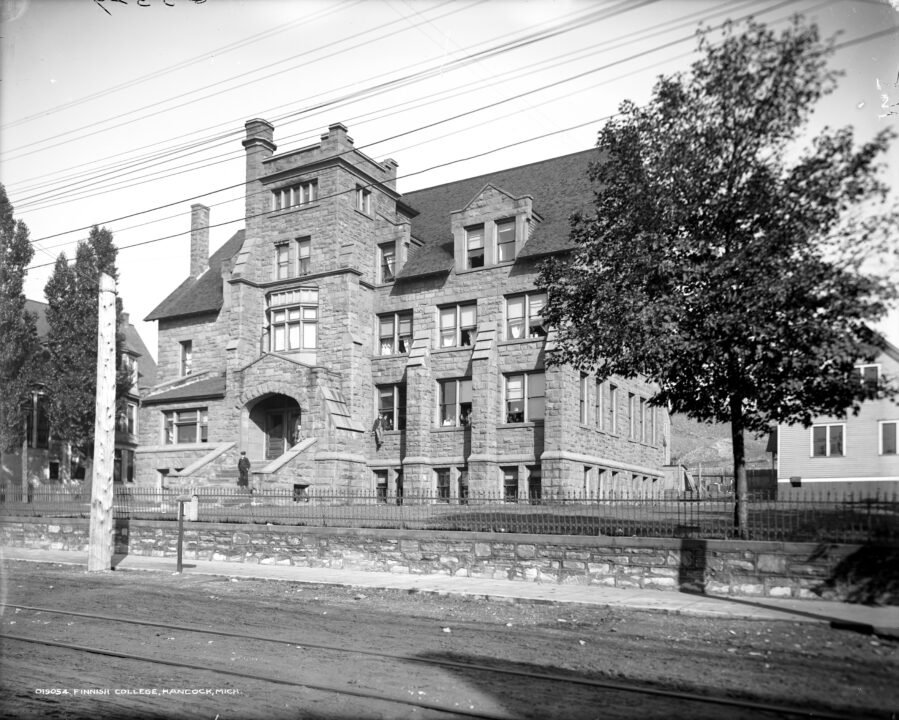
Both in Hancock and the surrounding area (Copper Country), Finnish heritage events such as Juhannus (Midsummer Eve) and Heikinpäivä (S. Henrik’s Day, 19 January) are organised throughout the year.
2026 Finno-Ugric Capital of Culture
The title of Finno-Ugric Capital of Culture was awarded to Hancock on 21 June 2025 in Narva, the previous Capital of Culture. Hancock was selected by a five-member independent jury on behalf of the URALIC Centre in Estonia, following an application and presentation by the city.
“The title of Finno-Ugric Capital of Culture in the US opens new bridges. Not only is it a chance for Hancock to introduce Americans to Finno-Ugricness, but it also gives us here in the East an insight into how our kindred peoples live on the other side of the ocean,” said jury chair Britt-Kathleen Mere (NGO Hõimulõimed).
According to Oliver Loode (URALIC Centre), Coordinator of the Finno-Ugric Capitals of Culture, the selection of Hancock as the next Finno-Ugric Capital of Culture is in line with the strategy of broadening the geography of Finno-Ugric cooperation by involving countries, peoples and communities not previously involved in the movement.
“The United States has strong communities of Finno-Ugric peoples, including Finns, Estonians, Hungarians, many of whom are already working together. The selection of Hancock as the 2026 Finno-Ugric Capital of Culture will give this a new impetus and create opportunities for new transatlantic cultural contacts,” said Loode.
Residents of Hancock learned the news on the final day of the traditional Midsummer celebrations.
“What a wonderful way to end the juhannus celebrations with the news that Hancock has been selected as the 2026 Finno-Ugric Capital of Culture!” commented James Kurtti – Honorary Consul of Finland in Michigan’s Upper Peninsula and one of the driving forces behind Hancock’s application.
- Video introducing the 2026 Finno-Ugric Capital of Culture (Facebook)
- Visit Keweenaw. Capitals of Culture
Programme
Within the framework of the Finno-Ugric Capital of Culture, some annual events and programmes are taking on a broader Finno-Ugric flavour. For example, Heikinpäivä, the first event of the Capital of Culture year on 24 January, offers Estonian and Hungarian delicacies as part of an ethnic food fair.

Other important events include Midsummer Day (20 June) and the Parade of Nations (19 September), as well as a programme summarising the year on Finnish Independence Day (6 December).
“Since there are no other significant Finno-Ugric communities in our region, we hope to receive feedback from across the country,” said James Kurtti, one of the organisers of the Capital of Culture and Honorary Consul of Finland in Michigan’s Upper Peninsula.
The cornerstone event of the year is the Midsummer Festival Juhannus Suurjuhlat (18-21 June 2026). The festival will feature lectures, presentations, an ethnic market, music and games, flag raising, bonfires, and excursions in the region. Both Estonian Ambassador Kristjan Prikk and Finnish Ambassador Kaisa Leena Mikkola have confirmed their attendance.
NEWS
- Hancock 2026 opening ceremony: aftermath (19.02.2026, Fenno-Ugria)
- Opening ceremony of Hancock 2026 (28.01.2026, Fenno-Ugria)
- Hancock, the 2026 Finno-Ugric Capital of Culture, unveils logo and preliminary programme (08.12.2025, Fenno-Ugria)
- 2026 Finno-Ugric Capital of Culture is Hancock, Michigan, USA (01.07.2025, Fenno-Ugria)
- 2026 Finno-Ugric Capital of Culture (01.07.2025, Visit Keewenaw)
- Celebrating Finno-Ugric Identity (29.06.2025, The Daily Mining Gazette)
- Hancock named as the 2026 Finno-Ugric Capital of Culture opens opportunities to meet new communities (26.06.2025, Keewenaw Report)
- Hancock receives Finno-Ugric Capital of Culture designation (25.06.2025, Iron Mountain Daily News)