Waterfowl Fund scholarship awarded to Britt-Kathleen Mere
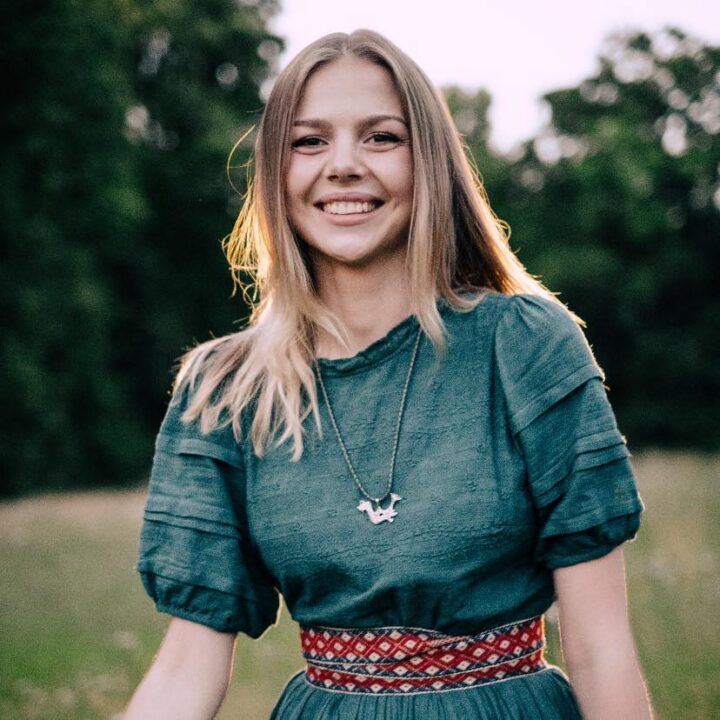
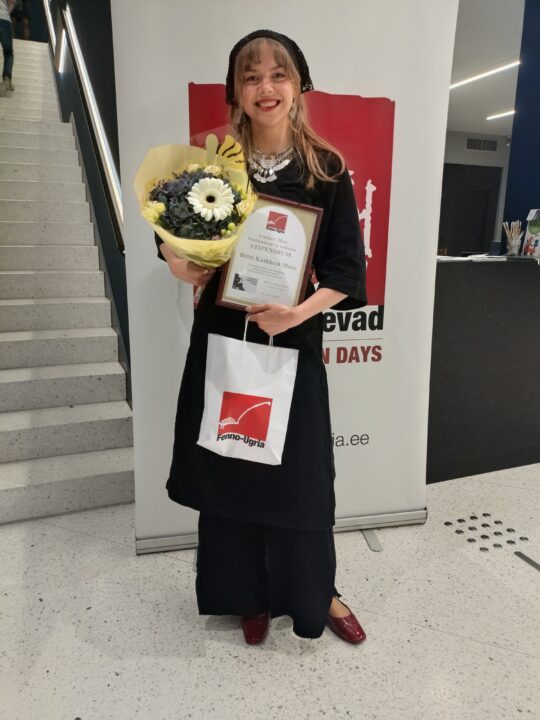
Britt-Kathleen Mere, a language data and content creation specialist at the University of Tartu, has been awarded the 2026 scholarship from the Lennart Meri Waterfowl Fund. She is the chair of Hõimulõimed, an organisation for the younger generation of Finno-Ugric peoples, a member and singer of the ensemble Kännu Peal Käbi, and an enthusiastic promoter of Finno-Ugric cultures.
Mere was born in Tallinn on 26 June 2000. In her day-to-day work, she develops digital solutions for Finno-Ugric languages and dialects. Her roots intertwine the parishes of Saarde and Rapla, as well as the Livonian heritage. She has worked as a freelance musical theatre actress, studied various languages, and is an enthusiast of Finno-Ugric culture and history with an eco-conscious outlook. In addition to her university studies, she has worked at the Estonian Literary Museum and at Uralic Centre, the organisation spearheading the Finno-Ugric Capitals of Culture project. Britt-Kathleen initially studied journalism and communication at the University of Tartu and was awarded a Bachelor’s degree in Estonian and Finno-Ugric linguistics from the University of Tartu in 2024.
Recognition speech by the Chair of the Board of the Lennart Meri Waterfowl Fund
Dear friends of our kindred peoples, dear guests!
The Kindred Peoples’ Days bring us together to listen to one another’s languages, to take pleasure in the songs and music of our peoples, and to recall how much unites us despite our differences. However, the bond between our kindred peoples does not rest solely on memories, traditions or festive occasions. It endures thanks to the people who value this bond and are prepared to take action themselves to preserve it.
In June 2007, the Lennart Meri Waterfowl Fund was established to support and recognise, in particular, the creative and community-oriented activities of young people for the benefit of the Finno-Ugric peoples. The Fund’s scholarship is awarded once a year during the Kindred Peoples’ Days.
There are people who take an interest in the world, and there are people who want to make the world a better place. Today’s laureate is one of those who do not limit themselves to asking what will become of our languages, cultures and peoples, but take action themselves to ensure a more secure future for them. Her work embodies several valuable qualities: a thirst for knowledge, initiative, creativity and a deep interest in the welfare of our kindred peoples. She understands that language is not merely a means of communication, nor is culture solely a legacy of the past. Language embodies people’s memory, worldview and sense of identity. When a language disappears, an entire unique way of understanding the world may be lost.This is precisely why her contribution to the study of Finno-Ugric languages and dialects – and to expanding their potential in today’s digital world – is so important. Technology can help small languages remain visible and in use even when the number of their speakers is small. In this way, the laureate combines scientific interest with practical forward thinking in her work.
Her work within the youth Finno-Ugric movement deserves special recognition. As a member and driving force within the community, she has helped to create an environment where young people can take the initiative, experiment, learn and take responsibility. This is much more than simply leading an organisation. It signifies a belief that cultural continuity does not arise of its own accord, but requires people who are willing to carry it forward.
Another appealing aspect of the laureate’s work is that, for her, culture is not confined solely to the world of books, lectures and research. Music, singing and the promotion of Finno-Ugric music help to bring the heritage of related peoples closer to people in a lively, direct and joyful way. In this way, culture becomes something that is not merely studied, but also lived and shared.The future of small nations and languages often depends on major achievements, but just as much on many small, consistent steps. A single project launched, a single language introduced, a single young person inspired, or a single partnership forged may prove to be more significant than we initially realise. The laureate’s work reminds us that heritage is not preserved solely by safeguarding it. It is also preserved by developing it further, opening it up to new generations and linking it to the opportunities of today.
All these fine sentiments apply to the 2026 scholarship recipient, Brit-Kathleen Mere. Let us therefore honour this young person who does not regard the future of our kindred peoples as someone else’s responsibility. She herself is ready to contribute to it – with her knowledge, energy, creativity and courage to take action. A huge thank you to you for helping our languages to be heard, our cultures to thrive and our kindred peoples to grow closer to one another!At the Kindred Peoples’ Day concert at the Ukuaru Music Centre in Rakvere on 10 October 2026.
Tõnu Seilenthal