Summary of Fenno-Ugria Report to the Ministry of Foreign Affairs
On 17 March 2026, Fenno-Ugria Foundation presented a report it had been commissioned, titled “The Situation of Finno-Ugric Peoples in Russia 2022–2024/25,” at the Ministry of Foreign Affairs. The report was compiled and edited by Barbi Pilvre, Director of Fenno-Ugria. Authors include Jaak Prozes, Advisor to Fenno-Ugria; Madis Arukask, Chairman of the Board and folklorist; Sven-Erik Soosaar, Board Member and linguist; and Vasily Nikolayev, Editor of the Mari news portal MariUver.
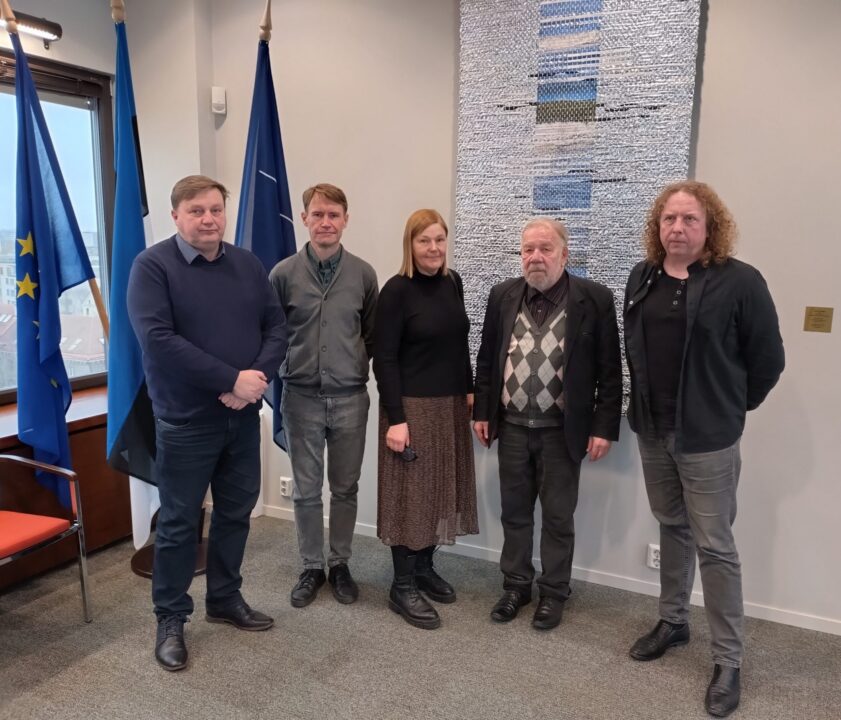
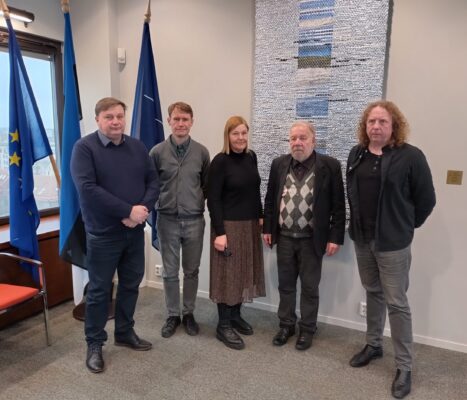
The meeting was opened by Imar Y. Koutchoukali, a research advisor at the Ministry of Foreign Affairs. Political scientist Kadri Liik gave a detailed presentation on Russia’s regional policy. The hall on the 10th floor was packed, and a brief discussion followed.
Background
As is well known, Russia launched a war against Ukraine in 2022 involving many minority groups, including Finno-Ugric peoples. This has radically altered the prospects for co-operation between our peoples, at least in the near future. Just as cultural exchanges with Russia have been severed on the Estonian side, international Finno-Ugric co-operation has also been declared politicised and obstructed by Russia.
Finno-Ugric organisations in Russia are under state control, and ethnic events and celebrations are subject to the ideology of Russian unity and military themes. The military is also seen among minority groups as a path to manhood and social advancement, and while average wages in the regions are low, military service offers high pay. In recent years, external contacts have been restricted, and the focus has been on strengthening central authority. To gain a better overview of the lives and activities of Russia’s Finno-Ugric peoples in the context of the war in Ukraine, where official cultural exchange and contacts have been severed, a comprehensive report was commissioned from the Fenno-Ugria Foundation.
Below is an overview of the report’s main findings.
Finno-Ugric peoples in Russia
According to the 2020/2021 census, Russia’s population stands at 147 million. Of these, nearly 1.7 million people identify as members of Finno-Ugric-speaking ethnic minorities, of whom only about 1 million consider their national language to be their native tongue. As recently as 2002, over 2 million people in Russia spoke Finno-Ugric languages.
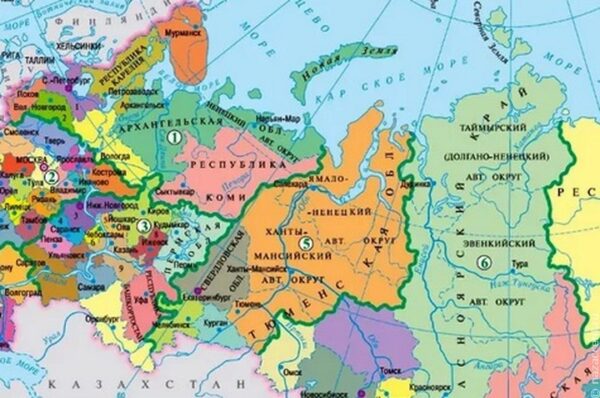
The Finno-Ugric ethnic groups are spread across a vast territory. The boundaries of their autonomous regions are arbitrary, and in all of them, the Russian-speaking population is in the majority. The proportion of Finno-Ugric peoples in their respective republics is 40% of the population among the Mari, 39% among the Erzya and Moksha, 25% among the Udmurt, 18% among the Komi, and even lower among the Karelians (6%). The proportion of indigenous peoples in their autonomous territories is even smaller, at around 1%, and the population there is also very scattered.
Finno-Ugric languages and language corpora
Since 2018, the teaching of Finno-Ugric languages has been optional in the Russian Federation and is available only upon a parent’s request. Until 2021, pupils could study their native language for two hours a week. Currently, it is recommended to limit this to one hour a week. The result is both weak proficiency in the native language and a decline in the number of pupils studying the national language.
Indigenous peoples are faring better: their numbers are either growing or have declined only marginally. This is primarily due to subsidies paid to indigenous peoples. Also, children from mixed families are counted among the indigenous population — for example, the number of Nenets is approaching 50,000. Behind the decline of the major ethnic groups lies an ever-accelerating process of assimilation. This, in turn, is fueled by the displacement of the native languages of the Finno-Ugric peoples from nearly all spheres of society, particularly education. In addition, over the past 15 years there has been a so-called “Campaign of citizens of Russia”, which has clearly made it uncomfortable to identify as belonging to one ethnic group or another.
Language corpora
In terms of language corpora and language technology support, the Mari, Udmurt, and Komi languages are in a better position. The largest text corpus is in the Komi language (88 million words). Yet, compared to Hungarian, Finnish, and Estonian, this is still very small. For example, the Estonian combined corpus currently in use contains 3.8 billion words. This is 40 times more than the largest Komi corpus. The Erzya, Moksha, and Hill Mari languages are in an even worse state, with corpora containing fewer than 10 million words. For Finno-Ugric languages with smaller numbers of speakers, such as Veps, Karelian, Ludic, Kildin Saami, Khanty, Mansi, and Samoyedic languages, language technology support is very weak, and corpora are either nonexistent or very small.
Finno-Ugric peoples and the war in Ukraine
Since 2022, Putin’s regime has mobilised people for its aggression against Ukraine primarily from rural areas of Russia. This of course includes regions inhabited by Finno-Ugric peoples. The dwindling and Russifying minority communities there have in some cases officially taken a pro-Putin stance. Still, one must ask to what extent the authorities are manipulating ethnic communities and to what extent support for the war is a forced position.
National battalions for military operations in Ukraine were formed immediately in 2022 in the Republics of Mari El, Udmurtia, and Mordovia, as well as in the Perm Krai. The names of the battalions are linked to the mythology and cultural symbols of the Finno-Ugric peoples.
The military is considered a “school of manhood”, and there is strong social pressure to enlist. Mobilisation is, of course, not just a problem for non-Russians. However, the more remote the region, the greater the likelihood that the military is the only social ladder. The average monthly salary in Russia is 15,000 rubles, or 150 euros. Contract soldiers, on the other hand, receive 300,000 rubles, or 3,000 euros, in a single payment.
Russia’s non-Russian ethnic groups (28 percent of the population) are generally loyal Russian citizens. Leaders of Finno-Ugric organisations support the mobilisation, and as government officials, they follow the chain of command.
National activity in militarised context
One key concept that characterises the current activities of the Finno-Ugric peoples in the Russian Federation is celebrations. Another key theme is the marking of their national cultural space with various memorial plaques and monuments, as well as the commemoration of figures and heroes of the national movement.
Various events are dedicated to the peoples’ anniversaries, which also incorporate war-related themes. Current themes are, for example, the Great Patriotic War, support for Russian soldiers, and recruitment. For example, it is said that contemporary Mari heroes are shedding blood in Russia’s military special operation in Ukraine. In connection with the republics’ birthdays, the Russian Federation’s newest holiday — National Unity Day — is celebrated extensively on 4 November.
Conclusion
Statistics on languages and ethnic groups confirm a trend toward the assimilation of nearly all ethnic groups in the Russian Federation. These groups seem to be losing their identity and language at an ever-increasing rate, as if in a melting pot. This assimilation is accelerated by the exclusion of the native languages of Finno-Ugric peoples from nearly all spheres of social life, particularly education.
Over the past decade, there has also been a so-called “Campaign of citizens of Russia”, which has clearly made it more uncomfortable to identify as a member of one ethnic group or another. This also affects the larger Finno-Ugric peoples — the Komi, Mari, Mordvins, and Udmurts — who are all in the minority in their own autonomous republics. Local people are being pushed out of positions of power. This causes the already low self-esteem of the Finno-Ugric peoples to decline even further.
The influence of Finno-Ugric peoples in their namesake republics is steadily diminishing, largely depending on the whims of the appointed head of state. Typically, a local is appointed as minister of culture or ethnic affairs. They are then allocated a certain amount of money to organise ceremonial events. The key themes of ethnic policy over the past three years have been Russian unity and the cessation of foreign relations, state governance, and central control. The events of nearly all Finno-Ugric organisations take place under the so-called banner of Russian unity.
Russian state control
Cooperation among Finno-Ugric peoples is kept under strict state control. These changes began to intensify following the 2014 occupation of Crimea. In particular, the central government took issue with the World Congresses of Finno-Ugric Peoples.
In April 2021, the Association of Finno-Ugric Peoples (AFUN) — which, in the view of the Russian government, is the only legitimate union of Finno-Ugric peoples’ organisations — that “in the international Finno-Ugric movement of recent times, destructive, clearly political tendencies have emerged particularly prominently in the international Finno-Ugric movement of recent times, which are also expressed in the activities of the World Congresses of Finno-Ugric Peoples, where the ‘Finno-Ugric card’ is used as a means of exerting pressure on one country or another, while ethnic issues are exploited for the purposes of ethnopolitical speculation.” It was also noted that Finno-Ugric congresses are not organised to find constructive solutions to problems. Rather, they are organised to be used to interfere in Russia’s internal affairs.
Future perspectives
In order not to undermine the valuable cultural co-operation among peoples — the kindred people movement — with Russia, Fenno-Ugria is prepared to restore relations should the situation change. This, however, will only be possible after the war ends.
In the new geopolitical situation, in which relations with Russia have broken down, Fenno-Ugria has focused on co-operating with local Finno-Ugric communities with ties to Russia in order to influence — even if only ideally — the related peoples living in Russia through them.
The full text of the report is available (in Estonian) on the Fenno-Ugria website.
FURTHER INFORMATION:
Barbi Pilvre, Jaak Prozes
info@fennougria.ee