Russian Saami activists resilient despite repression
At the end of the year, several searches were conducted in the regions of the Russian Federation among defenders of the rights of indigenous peoples. Selkup activist Daria Egereva and an environmental activist were detained and are still under preliminary investigation. They are accused of participating in the work of the Aboriginal Forum, which has been declared an extremist and terrorist organisation in Russia, but which unfortunately ceased its activities in 2024. The activists themselves believe that the real reason for the charges is their appearances at the UN Indigenous Peoples’ Forum in New York.
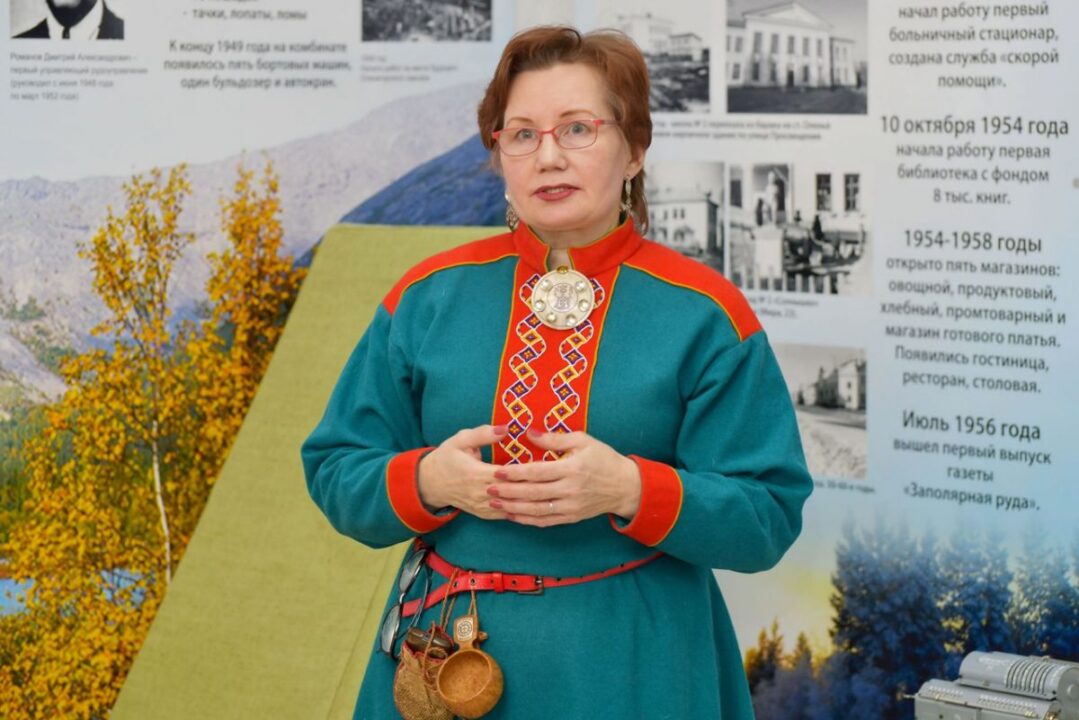
Here is a summary of an interview with Russian Saami activist Valentina Sovkina on the Polish broadcasting company’s international news portal Vot Tak and her appeal regarding the arrest of Daria Egereva on the website of Russia’s indigenous peoples.
Sovkina’s recount
Valentina Sovkina recalls the four-hour search: “At nine o’clock in the morning, there was a knock on the door. When I opened it, seven people entered, five men and two women. Three of them were wearing masks. The first thing they asked was, ‘Where is the equipment?’” Valentina tried to stop them, asking who they were. They showed her a piece of paper, but she couldn’t see it without her glasses.
When she entered the living room, one of the searchers followed her and grabbed the mobile phone next to her glasses. The other phone was under the pillow on the bed, and it was also taken away, and they demanded the codes needed to unlock the phones. Valentina did not give them. The searchers then said that since she did not give them the codes, she must have something to hide. Valentina replied that of course she had something to hide: her personal correspondence and photos that she sent to her husband.
Valentina then asked for a lawyer, claiming that she had the right to do so, to which they replied that this was not a search but an “inspection”. However, this “inspection” lasted four hours, with the searchers spreading out into different rooms, leafing through documents, books, and notebooks, and expressing surprise at how many there were. Valentina repeatedly asked what they were looking for. The answer was always the same: “We’re just looking.” In the end, the “inspectors” took her phones, an old notebook, and some software with them.
History of repression
Next, readers are introduced to the Saami people, who, according to the portal, number between 80,000 and 100,000, of whom 1,599 live in Russia, on the Kola Peninsula. Valentina Sovkina is presented as one of the most prominent activists in the Russian Saami national movement. The portal states that during Stalin’s reign, 118 representatives of the Saami people were repressed according to records, and the most famous criminal case against the Saami was the alleged “Saami conspiracy,” in which 15 Saami were shot and 13 were sent to labour camps.
Over the years, Valentina Sovkina has spoken at international forums about the rights of the Russian Saami people and criticised the seizure of indigenous lands by large industries. In 2022, Valentina Sovkina became a member of the UN Permanent Forum on Indigenous Issues on behalf of the Russian Federation, with a mandate until December 2025. Before her mandate ended, on 19 December, Valentina left the Russian Federation for Norway, where her husband already lived. She said she made this decision “on instinct”. “If I had stayed, anything could have happened. But if I leave, at least I have the opportunity to speak out”, she said. On her way to Norway, she reflected that history repeats itself.
Reactions
An anonymous source has commented on the detention of indigenous activists as follows:
“These people have spoken openly about how the lands where indigenous peoples have lived for centuries are being polluted by coal mining and oil drilling. It is becoming increasingly difficult to engage in hunting and fishing, and access to community lands has been restricted. The languages of indigenous peoples are dying out, village schools are being closed, and traditions are no longer being passed on to children. The life of indigenous peoples has been open and peaceful.”
To date, Valentina Sovkina has published an appeal on the Russian Indigenous Peoples website titled “It is a deliberate, coordinated state policy of intimidation”, republished in full below.
Valentina Sovkina. It is a deliberate, coordinated state policy of intimidation
Brothers and sisters, colleagues,
I address you today with anger and deep pain over the arrest of my sister and colleague, Darya Egereva, and in response to a new, large-scale wave of repression against representatives of the Indigenous Peoples of Russia. What we are witnessing is not a series of isolated incidents, nor the result of local abuses or individual misconduct. It is a deliberate, coordinated state policy of intimidation, suppression, and criminalization of Indigenous leaders — a policy aimed at breaking the will of our Nations.
I speak not only as a member of the United Nations Permanent Forum on Indigenous Issues, but also as a person who has herself become a target of these repressions. On 17 December 2025, my home in Lovozero was searched. Security forces invaded my private space, seized computers, communication devices, and documents. Similar searches and interrogations took place in the homes of other Indigenous activists across Russia. This was not coincidence — it was a planned and well-coordinated campaign of intimidation.
For us, this is not a new reality. As early as 2014, I and other Indigenous representatives were persecuted by security services for attempting to tell the international community the truth about the situation of Indigenous Peoples in Russia — including being prevented from leaving the country to attend a UN conference. Today, this practice has returned in a far more brutal form, and it is unfolding nationwide. Repressions against participants of the events in Baymak, criminal cases against Erzya Indigenous activists, and the detention of members of civic movement in the Altai Republic are only recent examples of how the state seeks to silence and destroy independent Indigenous voices.
Indigenous human rights defenders are being labeled extremists and terrorists simply for peacefully defending Indigenous Peoples rights — the right to traditional ways of life, culture, language, and basic human dignity. This is punishment for those who dare to speak the truth openly, including beyond Russia’s borders, at the United Nations and other international human rights platforms.
What is particularly outrageous is that Russian authorities accuse activists of terrorism, a charge that today carries monstrous prison sentences — 15, 20 years in prison — for people who have never committed violence and never called for it. These measures are not about “fighting terrorism.” They are instruments of fear. They are now being used against people who for centuries have lived traditional lives: herding reindeer, fishing, hunting, gathering food on their ancestral lands, and carefully preserving their knowledge — knowledge of nature itself.
We must call things by their proper names: this is not counterterrorism — it is political revenge. It is direct punishment by the state for the fact that Indigenous Peoples dare to apply to UN, to speak about violations of their rights, to participate in international mechanisms, and to tell the truth about what is happening in Russia. The Russian authorities are deliberately criminalizing the very idea of cooperation with the United Nations.
Today, space for free and independent expression in Russia has been almost entirely destroyed. Any criticism, any dissent, any independent civic activity is brutally suppressed. Especially cynical is the fact that repression is directed at the most vulnerable — the Indigenous Peoples of Siberia and the Arctic, who are socially marginalized, live in remote areas under harsh environmental conditions, have no political power, and remain largely invisible to the broader society. For our peoples, international law is often the only avenue for defending our rights. And it is precisely for this that we are now facing repression.
I must also underline the profound hypocrisy of the Russian state. While formally declaring support for Indigenous Peoples, for many years it has systematically destroyed independent Indigenous organizations, persecuted their leaders, and promoted state-controlled puppet structures on the international stage — such as RAIPON and various regional “advisory councils.” These bodies do not represent the real interests of Indigenous Peoples; they serve merely as a façade for repressive policies and as propaganda tools portraying a fictitious “happy life” of Indigenous Peoples in Russia.
The cynicism is particularly stark given that just recently, in November 2025, Vladimir Putin issued a decree establishing the “Day of Indigenous Small-Numbered Peoples of Russia” and the “Day of the Languages of the Peoples of Russia”, and declared 2026 the “Year of the Unity of the Peoples of Russia.” While the Kremlin announces holidays and speaks of “support,” on the ground searches, interrogations, and arrests of Indigenous leaders continue unabated.
I appeal to states, UN bodies, special procedures, international human rights mechanisms, Indigenous networks, and civil society organizations. Today, a clear, principled, and public response is urgently required. The international community must demand the immediate release of Darya Egereva, the release of other detained activists, and an immediate end to all forms of repression, criminal prosecution, and pressure against Indigenous Peoples in Russia. Criminal prosecution for peaceful human rights work and for engagement with the United Nations must cease.
For my part, I will raise this issue at the UN Permanent Forum on Indigenous Issues and other UN bodies. I will seek an international assessment of what is happening, protection for those unlawfully persecuted, and sustained attention to the grave and systemic violations of the rights of Indigenous Peoples in Russia.
And finally, I address Darya personally.
Dasha, my sister, you are not alone. Your courage and your voice have frightened those who are accustomed to acting in silence and with impunity. We stand with you. We speak, and we demand. Indigenous solidarity is stronger than prisons and repression. We are together.
Valentina Sovkina
Member of the UN Permanent Forum on Indigenous Issues (UNPFII)
- Valentina Sovkina. It is a deliberate, coordinated state policy of intimidation (Indigenous Russia, 23.12.2025)
- «История повторяется». Как в России начали преследовать активистов, рассказывавших о проблемах коренных народов в ООН (Vot Tak 09.01.2026, in Russian)
- Saami Parliament calls for the immediate release of Daria Egereva (Indigenous Russia 27.01.2026, in Swedish and English)